Transverse FWD vs. Longitudinal RWD: What are the Actual Differences in Handling?
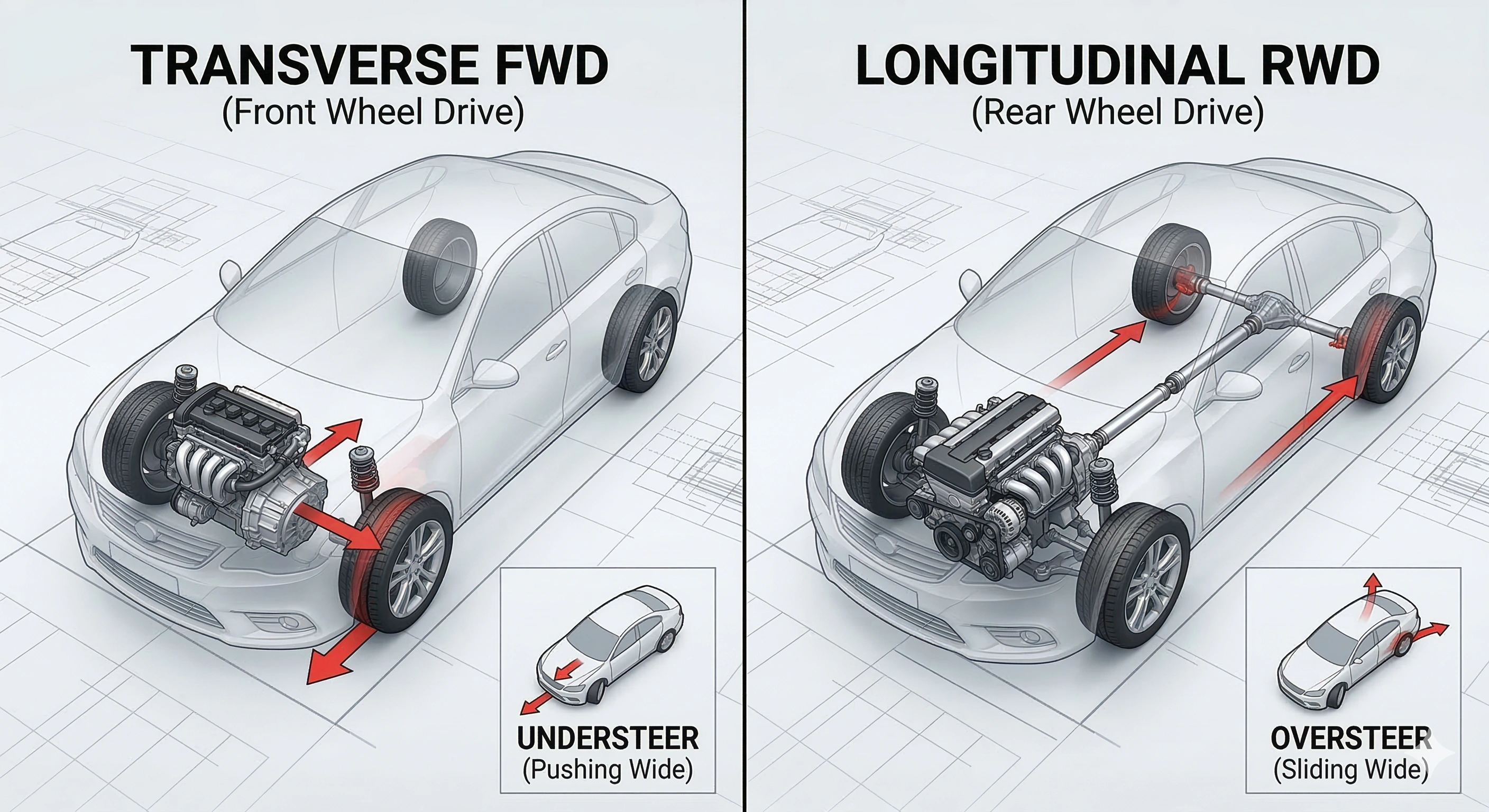
Following up on our previous discussion about steering drift, many readers have asked about the fundamental differences between “Front-Wheel Drive” and “Rear-Wheel Drive.” Let’s dive deep into how these two layouts shape your driving experience.
1. Transverse Front-Wheel Drive (FWD): The Space Magician
As the name suggests, the engine is placed “sideways” (transversely) in the front, delivering power directly to the front wheels. This is the most common layout for modern passenger cars, including most SUVs and sedans.
Driving Characteristics:
- Space Maximization: Because there is no long driveshaft running through the center of the car to the rear wheels, the engine bay can be shorter, allowing for more cabin and trunk space.
- Great Traction (Daily Driving): The weight of the engine and transmission sits directly over the driven wheels (front). This provides excellent traction when starting from a stop on rainy or slippery roads.
- The “Understeer” Limit: The front tires are overworked—they must handle both steering and power delivery. If you enter a corner too fast and exceed the tires’ grip, the car will suffer from Understeer. You turn the wheel, but the car continues to slide toward the outside of the curve.
- Torque Steer: As discussed in my previous post, unequal-length driveshafts can cause the steering wheel to tug to one side during hard acceleration in high-power FWD cars.
2. Longitudinal Rear-Wheel Drive (RWD): The Handling Specialist
In this layout, the engine is placed “lengthwise” (longitudinally), and power is sent through a driveshaft to the rear wheels. This is the gold standard for luxury sedans and high-performance sports cars.
Driving Characteristics:
- Superior Balance: Placing the engine longitudinally allows it to sit further back in the chassis. Combined with the rear differential, this often achieves a near-perfect 50:50 weight distribution, making the car feel much more balanced during cornering.
- Division of Labor: The front wheels handle steering, and the rear wheels handle propulsion. Since neither pair of tires is multitasking, the car can handle higher cornering forces with more precision.
- The “Oversteer” Thrill: When pushed to the limit, the rear end may lose grip, causing the car to rotate more than intended—this is Oversteer. While it requires more skill to control, it is exactly what makes RWD cars feel “tail-happy” and fun to drive.
- Space Trade-off: The “transmission tunnel” required for the driveshaft eats into the cabin space, often resulting in a large hump in the middle of the rear floor.
Conclusion: Which One is For You?
- Choose FWD if you prioritize fuel efficiency, interior space, and easy, predictable handling for daily commuting. It’s the practical choice for most drivers.
- Choose RWD if you value “the joy of driving,” steering precision, and high-speed stability. It’s the enthusiast’s choice for those who view a car as more than just a tool for transportation.
Regardless of the drive type, understanding your car’s physical limits is the first step toward safer and more enjoyable driving!