Deep Dive into API SQ Certification: Comparison Chart with SP, SN, and SM
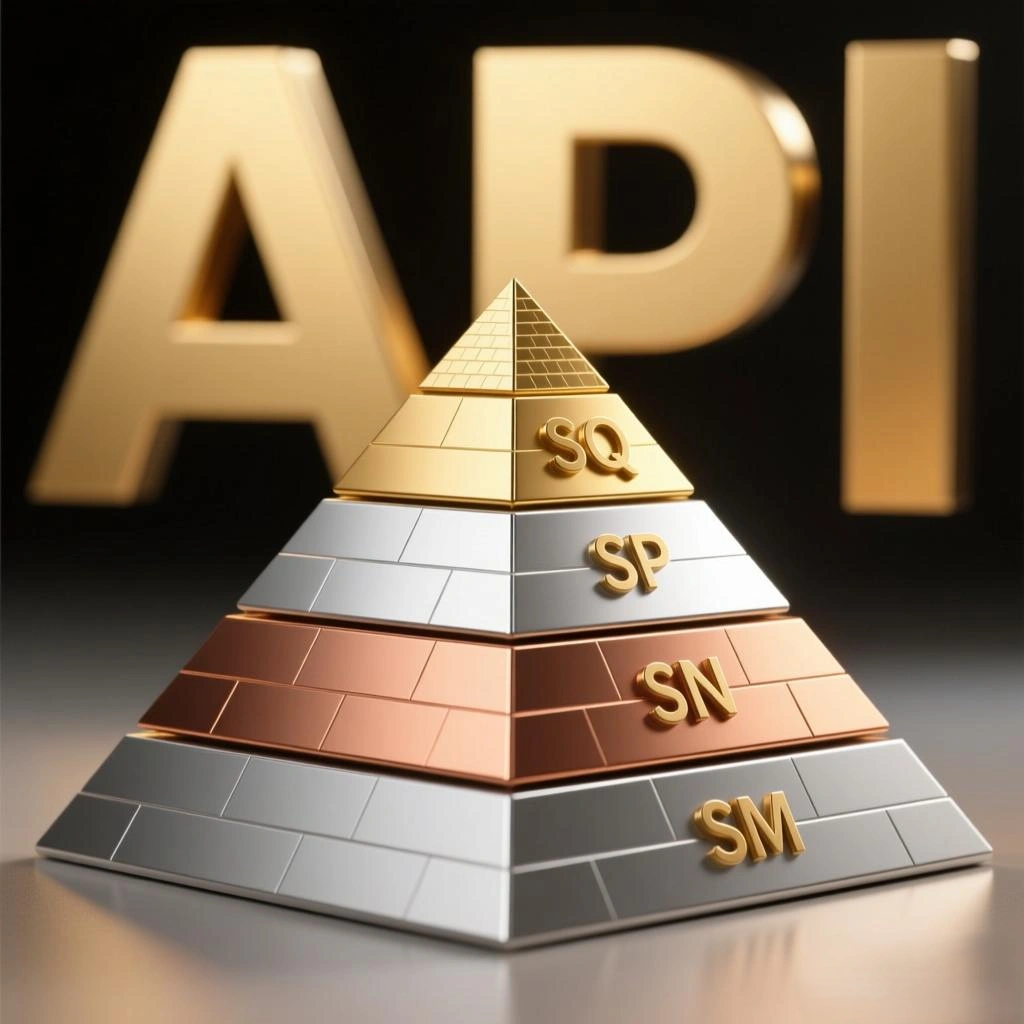
- No new engine oil specification represents a step backward in quality standards.
- The “newer is worse than older” claim is largely pseudoscience or a sales tactic used to flush out old inventory.
Technical Specification Comparison Table
| Testing Category (Sequence) | API SM (2004) | API SN (2010) | API SP (2020) | API SQ (2024) |
|---|---|---|---|---|
| Piston Deposits (IIIH) | N/A (IIIG) | No explicit req. | ≥ 3.5 pts | ≥ 4.0 pts |
| Viscosity Increase (IIIH) | ≤ 275% | ≤ 200% | ≤ 150% | ≤ 125% |
| Oil Volatility (IIIH) | N/A (IIIG) | No explicit req. | ≤ 80 mL | ≤ 60 mL |
| Low-Temp Sludge (VH) | Piston ≥ 4.0 (VG) | Piston ≥ 5.0 | Piston ≥ 7.6 | Piston ≥ 8.0 |
| Valvetrain Wear (IVB) | N/A (IVA) | Average < 90µm | Volume Loss < 2.7% | Volume Loss < 2.3% |
| LSPI Protection (IX) | N/A | N/A | Avg. 0 Pre-ignitions | Stricter Threshold |
| Timing Chain Wear (X) | N/A | N/A | ≤ 0.085% | ≤ 0.070% |
| Fuel Compatibility | Standard | Standard | Standard | Added E85 Support |
| Hybrid Optimization | No | No | Basic | Full Support |
Key Analysis of the API SQ (ILSAC GF-7) Standard
1. Superior Cleaning Performance (Sequence IIIH)
In the critical Sequence IIIH test, the requirement for piston deposits has been raised from 3.5 to 4.0. This means oils must possess even stronger detergency to prevent ring sticking and maintain engine compression over longer intervals.
2. Resistance to Thickening
The allowable viscosity increase has been further restricted to 125%. This ensures the oil maintains its flow characteristics and doesn’t turn into sludge under high-temperature stress, which is vital for modern turbocharged engines.
3. Timing Chain Protection
With the rise of direct-injection engines, timing chain wear caused by soot has become a major concern. API SQ lowers the allowable chain stretch from 0.085% to 0.070%, providing a safer environment for your engine’s internal timing components.
4. Global Emission Standards
API SQ is designed to be fully compatible with the latest GPF (Gasoline Particulate Filters) and DPF systems, ensuring that additives do not clog or poison expensive catalytic converters.
Conclusion
The evolution from API SM to SQ represents a steady climb in engine protection, efficiency, and environmental compatibility. When choosing oil in 2026, always prioritize the highest certification your vehicle supports. API SQ (GF-7) is not just a marketing label; it is a significantly tougher set of tests designed to meet the demands of modern GDI, Turbocharged, and Hybrid powertrains.