Analysis of Fatal Flaws in Automotive LTO Batteries: Why 5S Overcharges and 6S Undercharges?
The Core Issue: Car Alternator Charging Voltage
Most car and motorcycle alternators output around 13.5V to 14.4V while running, which is designed to float charge or recharge lead-acid batteries.
LTO Series Configuration and Voltage Matching
| Series | Nominal Voltage | Recommended Full Charge Voltage | Operating Voltage Range | Result |
|---|---|---|---|---|
| 5S | 11.5~12V | Approx. 13.5V (2.7V/cell) | 10V~13.5V | Constant Overcharge (Alternator voltage too high) |
| 6S | 13.8~14.4V | Approx. 16.2V (2.7V/cell) | 12V~16.2V | Undercharged / Low Capacity (Alternator voltage too low) |
Source of voltage specifications: Toshiba LTO Module Datasheet
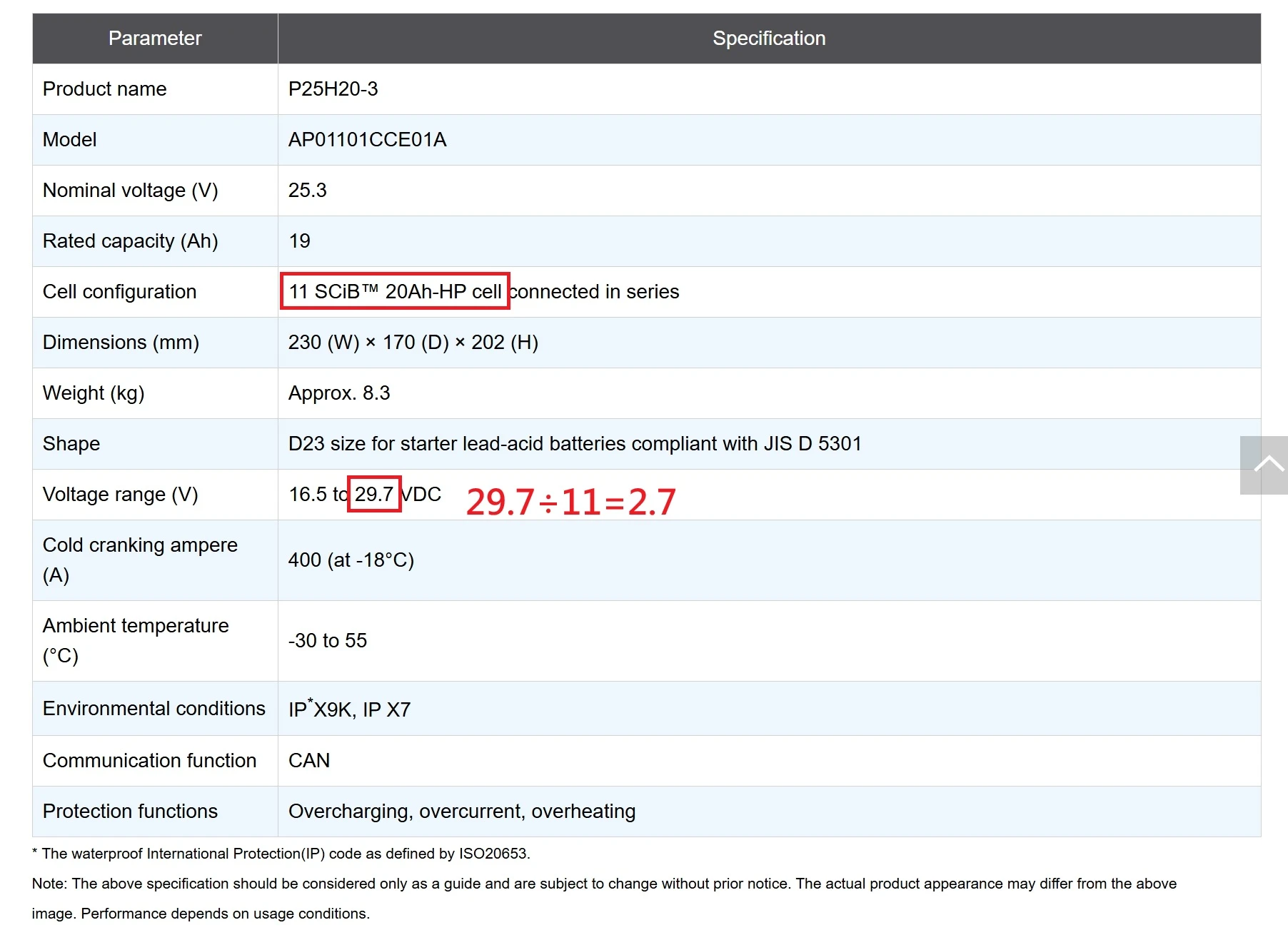
Fatal Flaw 1: Voltage Mismatch (5S Overcharges, 6S Undercharges)
Under the charging characteristics of car alternators, LTO cells face an awkward voltage matching dilemma, leading to a “5S overcharged, 6S undercharged” situation.
1. Why Does 5S Overcharge?
- Alternator outputs 13.5V~14.4V, divided by 5 cells = 2.7V~2.88V per cell.
- The minimum 13.5V already hits the voltage upper limit, meaning it is overcharging the entire time while driving.
- Long-term overvoltage charging causes:
- Severe capacity degradation (But the fatal part is: the internal resistance remains almost unchanged).
- Gas swelling and structural deformation.
- If a seller claims it can be charged above 2.7V, be sure to ask them for the official cell specification sheet as proof.
2. Why Does 6S Undercharge?
- Alternator outputs a maximum of 14.4V, divided by 6 cells = 2.4V per cell.
- 2.4V is merely the nominal voltage, far below the recommended 2.7V for charging.
- The essence of charging is “using an external power source to reverse a chemical reaction,” which requires applying a voltage higher than the battery’s natural output.
- If the voltage is not high enough, there is insufficient driving force to change the battery’s internal chemical state.
Possible Results:
- Usable capacity drops to only 30% ⬇️
- Worsened polarization phenomenon.
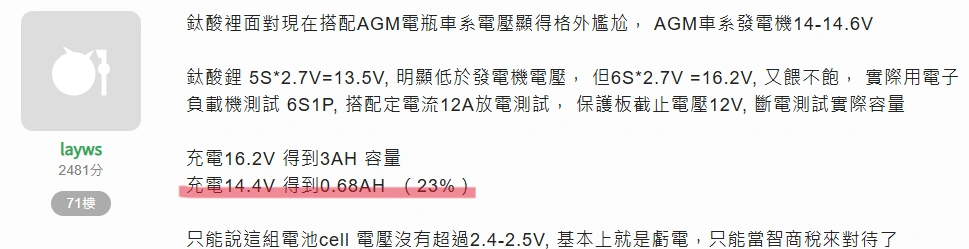
Fatal Flaw 2: Temperature Limits (Cell Must Not Exceed 55°C)
In addition to the voltage matching issues, LTO batteries have strict temperature limits. Toshiba’s specification sheet shows:
- Ambient Temperature: -30°C to 45°C (Type 1-23), -30°C to 50°C (Type 4-23)
- Cell Temperature: Must not exceed 55°C during charge/discharge
Why Is It Unsuitable for Car Starting?
- Engine Bay Heat: Temperatures during operation often reach 70°C to 80°C, far exceeding the cell limit.
- Swelling Risk: High temperatures accelerate internal gassing, making second-hand cells more prone to swelling and deformation.
- Rapid Lifespan Decay: Operating above 55°C for long periods makes the cycle life practically worthless.
Recommendation: If you must use LTO in a car, it should be relocated to the cabin or trunk with good thermal insulation and ventilation. Placing it directly in the engine bay is slow self-destruction.
Fatal Flaw 3: The Data Illusion of Ultra-High CCA and Internal Resistance
Many DIY enthusiasts testing LTO cells are often deceived by two sets of beautiful data: Ultra-high CCA (Cold Cranking Amps) and extremely low 1kHz AC internal resistance. Many think they have struck gold, but this is a severe cognitive blind spot.
1. Beautiful CCA and Internal Resistance Data Are Actually “Fake”
First, a lithium battery’s internal resistance does not equate to its actual discharge capability. Taking the Toshiba official LTO specification sheet as an example, its discharge rate is actually only 20C. Measuring an ultra-high CCA using traditional instruments is practically meaningless (Further reading: Why measuring CCA for lithium batteries is meaningless).
Why is LTO’s continuous discharge rate lower than LiFePO4 (20C vs. 50C–80C) despite having much lower internal resistance? The key reasons are:
- Cathode Concentration Polarization: The ultra-low internal resistance on spec sheets is only static or instantaneous impedance. During continuous high-current discharge, lithium-ion diffusion in the cathode cannot keep up (concentration polarization), causing voltage to drop rapidly.
- Extremely Narrow Voltage Window: LTO has a nominal voltage of only 2.3V (cut-off voltage 1.5V), offering a usable voltage drop window of only ~0.8V (far smaller than LiFePO4’s 1.2V). Any slight voltage drop and polarization under heavy load instantly trips the 1.5V cut-off threshold, causing the system to shut off for low voltage.
More fatally, LTO’s unique electrochemical properties (zero-strain material and less likely to form a traditional SEI layer) mean that during the early stages of aging or when internal gassing occurs, its ohmic internal resistance changes are not obvious. Common 1kHz internal resistance meters can only measure static AC impedance. Therefore, whether the usable capacity of this second-hand cell has degraded or the interior is starting to gas severely, the measured internal resistance data often remains very attractive, making it highly deceptive.
2. The True Face of Discarded Cells: “Pretenders” Whose Capacity Has Degraded But Internal Resistance Appears Healthy
Industrial module factories discard these batteries because their professional monitoring systems detect “actual Ah capacity degradation” and “extremely severe self-discharge (voltage drops rapidly when left unused).”
When these end-of-life (EOL) scrapped cells enter the second-hand market, their trait of “obscured internal resistance changes, making them highly deceptive” makes them perfect pretenders. Without professional equipment to conduct a 10+ hour “full charge/discharge actual capacity test,” ordinary players relying solely on internal resistance meters will absolutely fail to identify them.
3. Hidden Trap: Low Capacity Doubles Cycle Wear
Besides the undetectable aging, LTO has another fatal flaw:
- Extremely low energy density: At the same volume, LTO’s capacity is less than half of Lithium Iron Phosphate (LiFePO4).
- Rapid cycle wear: Because the capacity is small, the consumption ratio per charge/discharge cycle is relatively higher, causing the lifespan to degrade twice as fast.
Conclusion: The much-touted ultra-long lifespan of LTO is based on the premise of “brand-new cells.” Currently, the market is flooded with industrial scrapped cells. Given the inherent disadvantages of low energy density and high cycle wear, if buyers blindly purchase based on internal resistance or CCA, the actual lifespan and performance they get are often worse than a brand-new set of LiFePO4 batteries.
Comparison of Common Batteries in the Market
| Size LN3 | Lead-Acid | LTO | LiFePO4 |
|---|---|---|---|
| Capacity | 70Ah | 46Ah | 100Ah |
| Charge Perf. | 7A(0.1C) | 920A(20C) | 200A(2C) |
| Discharge Perf. | 10C | 20C | 50-80C |
| Max Voltage | 16.2V | 13.5V(5S) | 14.6V |
| Cycle Life | 1000 times |
Ideal 20,000 times x Capacity 0.46 x Used Wear 0.7 x Constant Overcharge 0.7 =4500 times |
5000 times |
| Cell Quality | Brand New | Mostly used/dismantled | Brand New |
| Manufacturer | Regulated Factory | Mostly underground factories | Regulated Factory |
| Price | Low | High | Medium |
|
European Car Alternator: 190A Japanese Car Alternator: 120A |
|||
Recommendation: If you are choosing an LTO battery for car starting purposes, please make sure the series configuration matches the charging voltage. Also, be aware of the “false health” characteristic of used cells on the market, which lose capacity without increasing internal resistance. Demanding actual discharge capacity test reports from the vendor is far more important than comforting yourself with numbers on an internal resistance meter.