LiFePO4 Battery vs. Supercapacitor: Which Should You Choose?

If you have a budget and want to upgrade your vehicle’s electrical performance, you might face a choice:
👉 Should you spend the money to install a “Supercapacitor”?
👉 Or should you directly upgrade to a “LiFePO4 (Lithium Iron Phosphate) Battery”?
Let me give you the answer directly: Installing a supercapacitor is not just an expensive detour; it’s actually a “downgrade.”
Basic Electrical Principles: Parallel Formulas and Current Division
Before discussing this, let’s review two key concepts:
1. Parallel Formula
The total impedance formula for parallel resistors is: (Parallel Resistance Calculator)
RTotal Impedance = RBattery IR × RCapacitor IR RBattery IR + RCapacitor IR
This means: If the impedance of one component is significantly lower than the other, the improvement in total impedance is very limited.
2. Current Division Principle
Current is like water flow; it will always prioritize the path with the lowest impedance (internal resistance). When a load (like a starter motor or subwoofer) requires a momentary large current, whichever component has the lower internal resistance will be the one supplying the power.
Reason 1: The LiFePO4 Battery is Already a Performance Beast
The original intent behind designing supercapacitors was to compensate for the flaws of traditional lead-acid batteries, which have “high internal resistance and slow response“—much like adding a cache in front of a slow hard drive.
However, a LiFePO4 battery inherently possesses:
- Extremely low internal resistance
- High discharge rate (C-rate)
- Extremely fast response
👉 The discharge capability of LiFePO4 has long surpassed the “auxiliary” role a supercapacitor can provide.
Reason 2: Supercapacitors Respond Slower Than LiFePO4
Theoretically, capacitors possess extremely low physical internal resistance and ultra-fast charge-discharge characteristics. However, commercial supercapacitor modules require multiple cells connected in series and the addition of balancing circuits, which often pushes the total system internal resistance (ESR) to 20mΩ or more—surpassing even that of an aging lead-acid battery. When a vehicle demands a sudden high-current burst (such as during ignition or A/C compressor engagement), the severe voltage drop caused by high ESR prevents energy from being released effectively and converts it into significant waste heat. As a result, the practical transient response and burst power of supercapacitors are actually inferior to high-quality LiFePO4 batteries, which boast a mere 2-3mΩ internal resistance.
Reason 3: Paralleling LiFePO4 with a Supercapacitor Yields Negligible Results
Going back to the parallel formula and current division principle mentioned earlier:
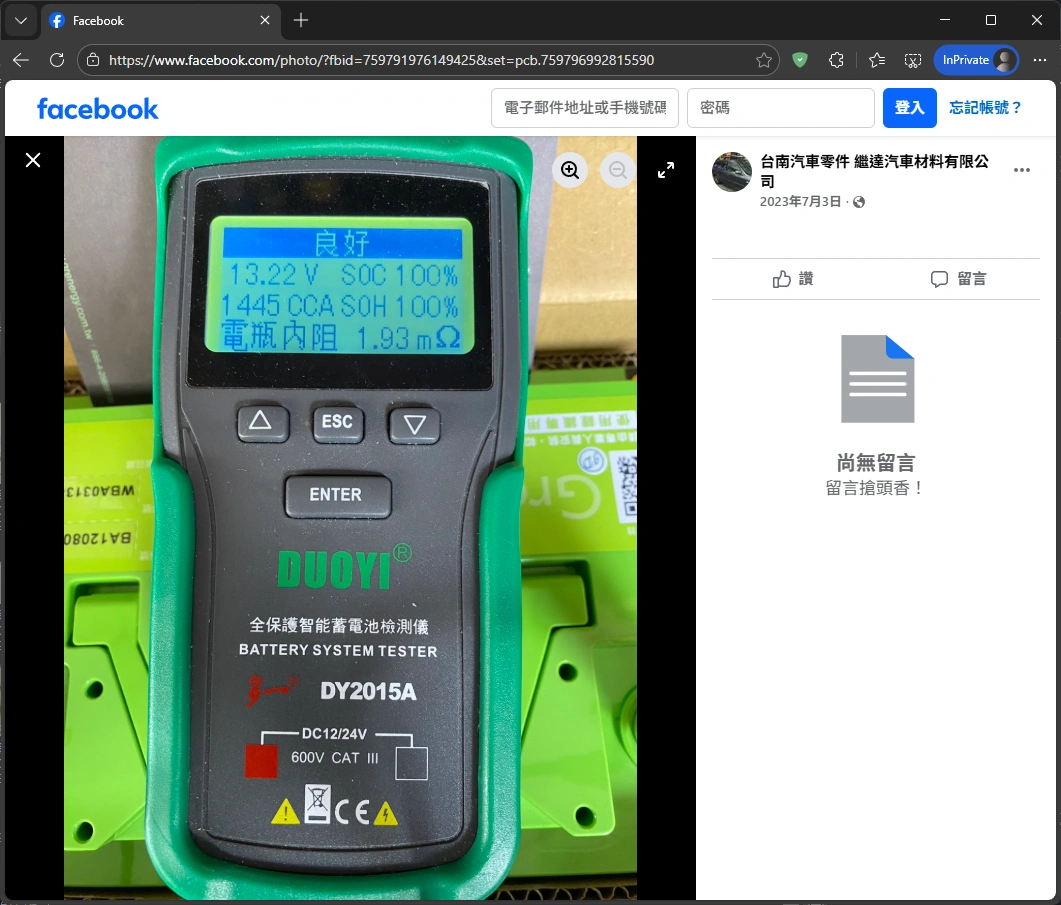
- LiFePO4 battery DC internal resistance: About 2–3 mΩ
- Commercial capacitor module internal resistance: About 20–30 mΩ
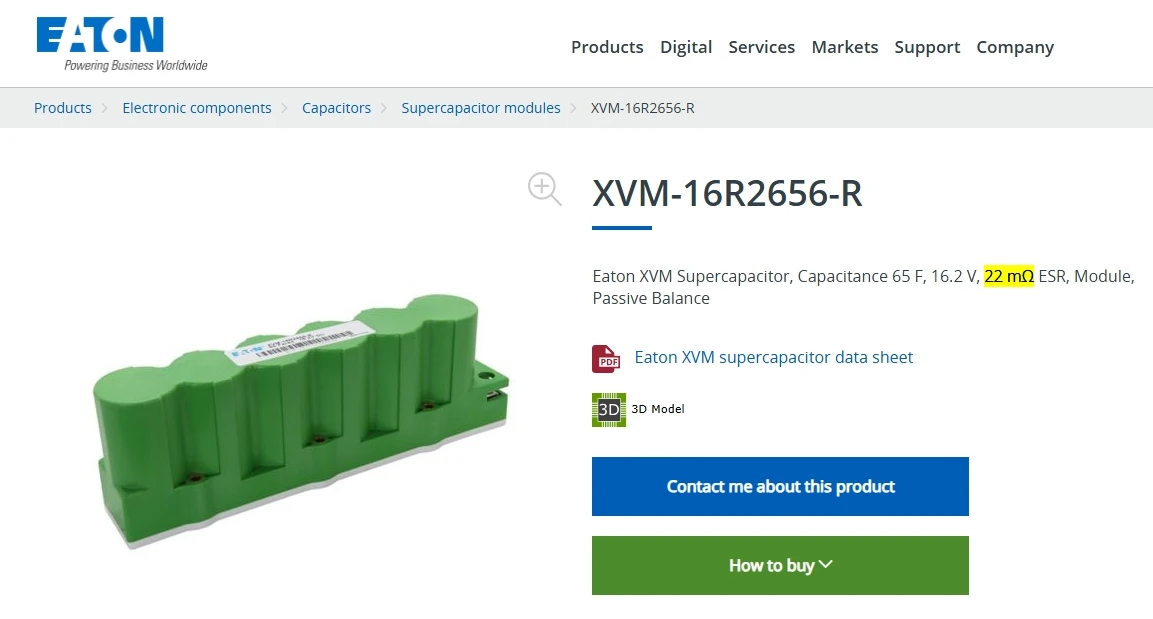
Using the formula, paralleling a GreenRun LiFePO4 battery with an Eaton supercapacitor only reduces the total internal resistance by about 0.15mΩ, which might even be offset by the wiring impedance.
According to the current division principle, the current is mainly carried by the low-resistance LiFePO4 battery, rendering the capacitor almost entirely useless.
Next time you see manufacturers touting the miraculous effects of supercapacitors, look closely at what they are comparing it against. The vast majority are “Lead-Acid + Parallel Capacitor vs. Original Lead-Acid.” They almost never show data for “LiFePO4 + Parallel Capacitor vs. Standalone LiFePO4” because that would prove spending all that money makes: Almost no difference.
Reason 4: High Self-Discharge of Capacitors
Besides having small capacity and being sensitive to high temperatures, supercapacitors also suffer from “fast self-discharge.” Even when not in use, it will continuously leak power. The self-discharge levels are:
- Supercapacitors: A few mA to hundreds of mA
- LiFePO4 batteries: Only tens of μA (1mA = 1000μA)
If the vehicle is parked for just a few days, the voltage of the supercapacitor will drop significantly, becoming an extra burden on the battery (the battery is forced to charge the capacitor).
Reason 5: Add-ons Bring Additional Risks
- Installation Risk: Extra wiring can chafe and short-circuit, or even become a projectile in a collision.
- Product Risk: There have been cases of supercapacitor failures leading to short circuits, high temperatures, and even vehicle fires.
In contrast, a LiFePO4 battery is a direct “one-to-one” OEM location upgrade:
- High integration
- Stable structure
- Aging or failure typically only results in swelling, making it highly safe.
Reason 6: LiFePO4 Batteries Have Become Affordable
In the past, when LiFePO4 batteries were expensive, supercapacitors had a market niche. Today, the price of LiFePO4 has dropped drastically:
- Branded 100Ah LiFePO4 battery for cars: Approx. NT$12,000
- Branded 5.5Ah LiFePO4 battery for motorcycles: Approx. NT$2,500
👉 Since LiFePO4 battery prices are now approachable, why spend over ten thousand dollars on a supercapacitor that has less than 0.4Ah, high internal resistance, slow response, is afraid of heat, and “steals” electricity?
Reason 7: The Capacity of Supercapacitors is “Too Large” for Filtering
Supercapacitors sit in an awkward middle ground: they are too small to be batteries, yet too cumbersome for filtering. In the world of electrical filtering, “speed is king,” and that is the supercapacitor’s greatest weakness.
- The Side Effects of Massive Capacity: Due to their complex internal structure, supercapacitors react extremely sluggishly to high-frequency noise. The noise simply slips through before the supercapacitor can even begin to respond.
- Low-Frequency Energy Buffering: LiFePO4 (Lithium Iron Phosphate) batteries are already top-tier low-frequency buffers. In a system already equipped with one, a supercapacitor is redundant.
- High-Frequency Noise Filtering: Effective filtering requires the “right tool for the job.” For instance, early voltage stabilizers used a combination of small capacitors (such as electrolytic, ceramic, or film) to precisely intercept noise at various frequency ranges. Supercapacitors are too slow and have massive ESL (Equivalent Series Inductance), making them completely ineffective against high-frequency interference.
👉 Adding a supercapacitor for “filtering” or “electrical system improvement” is entirely redundant in today’s era of affordable LiFePO4 batteries.
Spend Your Money Wisely
In conclusion, the era of supercapacitors in the car modification market is over.
- If you use a LiFePO4 battery: A parallel capacitor is ineffective because the LiFePO4 is more powerful than the capacitor, making the capacitor’s role negligible.
- If you use a lead-acid battery: A parallel capacitor is not cost-effective because directly upgrading to LiFePO4 yields stronger performance and greater safety.
👉 Save the budget you would have spent on a supercapacitor and invest directly in a high-quality LiFePO4 battery. That is the most direct and effective upgrade method.