An Analysis of the Functions of Engine Underbody Panels
Automotive aerodynamics often focus on the roof, rear wing, or front bumper, but the chassis actually has the greatest impact. Installing a well-designed “engine underbody panel” can flatten the chassis, improve high-speed stability, and reduce fuel consumption, making it a highly efficient modification. Many imported cars come with complete underbody kits from the factory, but some domestically produced or specific versions (such as the Taiwan version of the RAV4 gasoline model) often omit them.
The Three Major Aerodynamic Advantages of a Flat Underbody
Traditional unflattened vehicle underbodies are full of exposed oil pans, transmission cases, exhaust pipes, and various suspension links. When the vehicle travels at high speeds, these uneven structures generate severe “turbulence.”
This not only affects the dynamic behavior of the vehicle but also directly impacts fuel consumption. Let’s look at the specific scientific data:
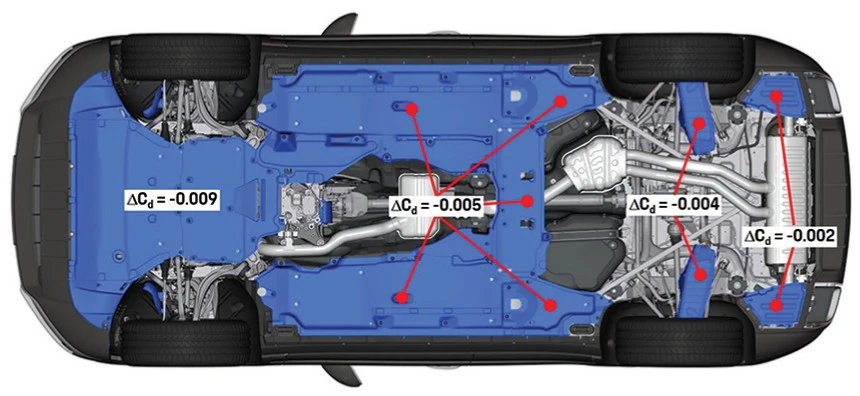 (Image Source: Porsche Aerodynamics Study)
1. Reducing Drag: Fuel-Saving Benefits May Exceed “Lightweight Wheels”
According to Porsche research, the aerodynamic benefits of a flat underbody decrease from the front of the car to the rear, making the front-most “engine underbody panel” the key to cutting through the wind. Merely sealing the area under the engine bay can reduce the drag coefficient (Cd) by about 0.009; if full underbody flattening is achieved, drag can be reduced by 6%.
The benefits of the drag coefficient:
- Power Consumption: For every 0.01 increase in the Cd value, an additional 1 horsepower is required at a speed of 100 km/h.
- Range Improvement: For every 0.001 decrease in the Cd value, the range can increase by 1 kilometer. Reducing it from 0.35 to 0.30 can increase the range by 50 kilometers.
Compared to expensive lightweight wheels, underbody panels often offer a higher cost-performance ratio in terms of “saving fuel, maintaining inertia, and reducing wind noise.”
2. Reducing Lift and Resolving the Floating Sensation at High Speeds
Beyond reducing drag, the key to underbody flattening lies in controlling “lift” (Cl). The “boating sensation” experienced when changing lanes at high speeds is often caused by an uneven chassis amplifying airflow fluctuations.
- Combating Crosswinds and Lift: Studies show that when encountering crosswinds, the lift generated by a flat underbody is significantly lower than that of an exposed underbody, effectively reducing the vehicle’s “floating” phenomenon.
- Ground Effect: According to Bernoulli’s principle, a flat panel allows airflow to pass quickly, creating a low-pressure suction area under the car. This can enhance tire grip and improve stability during high-speed driving without increasing vehicle weight.
3. Optimizing Engine Bay Heat Dissipation
Many people intuitively believe that sealing the underbody space with a panel will hinder heat dissipation, but this is actually a misconception. Effective heat dissipation does not rely simply on “open space,” but rather requires “airflow guidance”:
- The “Extraction Effect” at High Speeds: A flat panel speeds up the airflow under the car. According to physical principles, where the flow velocity is high, the pressure is low, which creates a “suction” force on the engine bay, actively “extracting” hot air out through the diversion holes. The heat dissipation efficiency is actually better than an exposed chassis where turbulent air scatters everywhere.
- “Forward Guidance” at Low Speeds: During traffic jams or low-speed driving, heat dissipation relies mainly on the forced operation of the cooling fans. A well-designed panel can act as a deflector, using the positive pressure built up by the fans in the engine bay to guide the hot air toward specific exhaust vents flowing to the rear of the vehicle. This effectively prevents hot air from wandering aimlessly within the engine bay or heat stagnation caused by rebounding off the ground.
Plastic-Steel vs. Metal: How to Choose?
Mainstream materials currently on the market are divided into two major categories: “Plastic-Steel (PP/PE/ABS)” and “Metal (Aluminum Alloy or Manganese Steel)”:
| Feature | Plastic-Steel | Metal |
|---|---|---|
| Weight | Lightweight. It adds almost no burden to the vehicle body. | Heavier. Manganese steel is the heaviest, followed by aluminum alloy. |
| Protection Level | Medium. Can protect against muddy water, flying stones, and minor scrapes. | Extremely High. Can withstand severe bottoming out and hard object impacts. |
| Toughness and Deformation | Elastic. Recovers from slight pressure, but will crack under heavy impact. | Inelastic. Heavy impacts will cause permanent denting and deformation. |
| NVH (Noise, Vibration, Harshness) | Excellent. Absorbs engine noise and does not produce resonance. | Poorer. Easily reflects noise and prone to metal resonance noises if poorly installed. |
| Applicable Scenarios | 90% of daily commuting, high-speed cruising, mountain runs. | Off-roading, frequently driving on industrial or construction roads. |
Summary Recommendation: If you are doing general commuting and highway driving, and your main goal is “aerodynamic flattening” for fuel savings and “reduced wind noise,” then plastic-steel is definitely the first choice, as it is lightweight and produces no abnormal noise. However, if you are passionate about off-roading, camping, and frequently face the risk of “bottoming out,” you should choose aluminum alloy or manganese steel to provide more protection for your chassis.
By the Way: Does Installing a Hard Underbody Panel Affect the “Engine Dropping” Safety Mechanism?
After choosing a rigid metal underbody panel, a common safety myth is often heard: “In a frontal collision, the engine is designed to drop downwards (Engine Dropping Design). A hard panel might support the engine, causing it to push into the cabin and crush the driver!”
This concern sounds reasonable, but it is entirely unfounded in terms of physical magnitudes:
- Disparity in Magnitude: During a severe collision, the inertial shear force required to trigger the engine dropping mechanism usually reaches over 10 tons. Commercially available underbody panels are typically secured to the edge of the subframe by just a few M6 or M8 screws.
- Vulnerable Resistance: When 10 tons of kinetic energy press down along the subframe, these small screws will be instantly uprooted, and the panel will be easily torn like aluminum foil. The resistance it can provide is completely negligible in the face of massive impact kinetic energy.
Simply put, the rigidity of the panel is only enough to withstand daily flying stones and chassis friction, but in a life-threatening high-speed collision, it absolutely cannot stop the physical trajectory of the engine dropping.
Conclusion
An engine underbody panel is not just a simple “shield”; it is a crucial puzzle piece for perfecting vehicle aerodynamics, improving fuel efficiency, and enhancing driving stability. By clarifying your own vehicle usage needs to select the appropriate material and dispelling unnecessary safety myths, you can more confidently enjoy the high-speed cruising pleasure brought by underbody flattening!
References
- https://www.ptt.cc/bbs/car/M.1725892185.A.A4A.html
- https://journals.sagepub.com/doi/10.1177/1687814018797506
- https://www.extrica.com/article/19210