Analysis of Motorcycle ISG Electric Boost System: How It Works, Performance Gains with LiFePO4 Battery Upgrades, and Physical Limits
In recent years, many mainstream motorcycle brands (such as SYM, Kymco, and Yamaha) have introduced ISG (Integrated Starter Generator) technology into their models. In addition to providing vibration-free ‘silent start’ and ‘idle stop-start’ features, the ‘electric boost (Motor Assist / Mild Hybrid)’ has become a major selling point for improving ride quality.
However, many riders notice that when the factory-installed lead-acid battery is used, the electric boost feels relatively weak. If upgraded to a ‘Lithium Iron Phosphate (LiFePO4) battery’, the sensation of being pulled forward when starting or twisting the throttle is significantly enhanced. What is the mechanism behind this? Why do physical limitations still exist that cannot be overcome even after upgrading the battery? This article provides a comprehensive analysis.
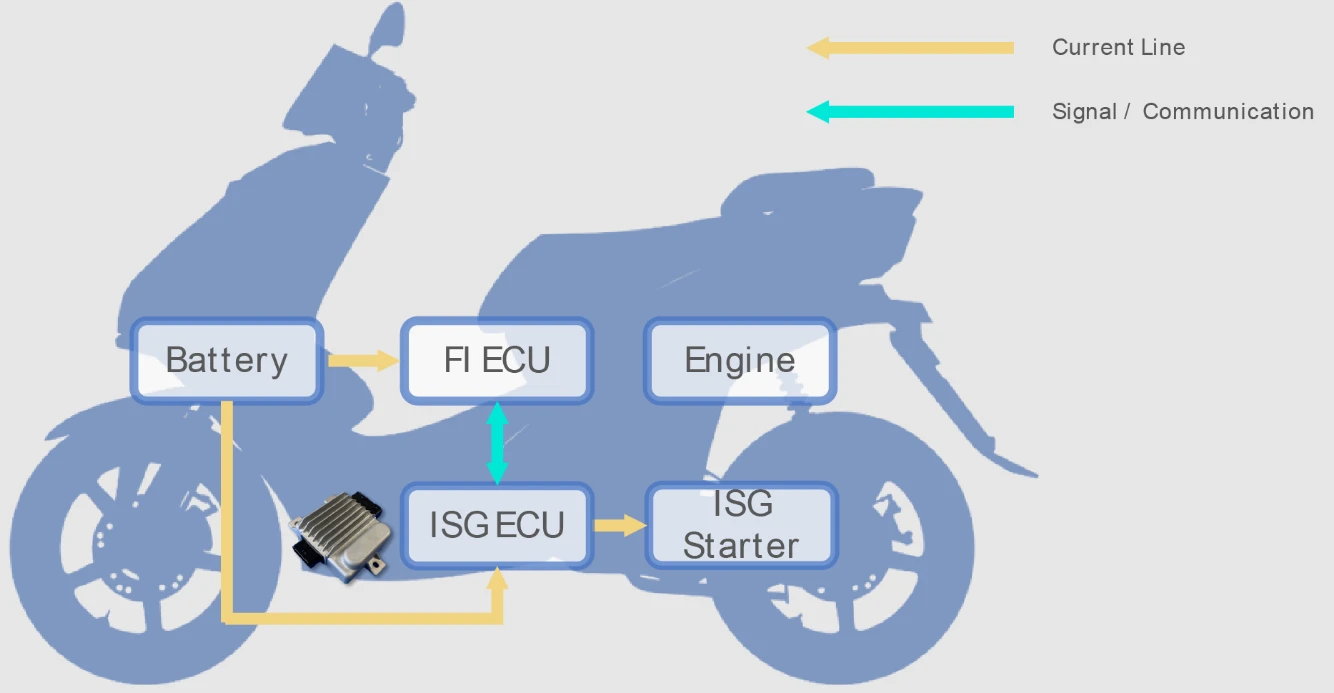 Image Source: Shindengen
What is ISG? Working Principle and Dual Roles
In traditional motorcycle electrical architectures, the starter motor and the generator (magneto) are two independent components. During start-up, the starter motor must turn the crankshaft via gears, which often produces a loud, harsh clattering sound and noticeable vibration.
ISG integrates these two components into one, directly mounting the brushless motor’s stator and rotor onto the engine’s crankshaft. It operates in three distinct modes:
- Silent Start Mode (Motor Operation): Drawing electrical energy from the battery, it directly spins the crankshaft to start the engine, completely eliminating traditional starter gears and achieving a silent, vibration-free, and rapid startup.
- Electric Boost Mode (Motor Assist): When the vehicle starts moving or the throttle is suddenly opened, the controller drives the ISG motor to output additional torque, giving the engine a ‘push’ directly on the crankshaft to compensate for the torque valley of internal combustion engines at low RPM.
- Power Generation & Kinetic Energy Recovery Mode (Generator): When the engine is running normally or the vehicle is decelerating, the ISG switches back to a generator state, converting the mechanical energy of the engine or the deceleration kinetic energy of the vehicle into electricity to recharge the onboard battery.
Inherent Limitations of the ISG Electric Boost System
Although the ISG can provide instant power assistance, it is fundamentally different from a car’s 48V mild hybrid or a pure electric vehicle (EV), mainly limited by the following factors:
- Power Bottleneck of the 12V Low-Voltage System: According to the power formula \(P = V \times I\) (Power = Voltage × Current), to output 1 kW (about 1.35 hp) of electric boost power in a standard 12V motorcycle architecture, the transient current on the battery side will exceed 90–100 Amps after accounting for the conversion efficiency of the controller (MCU) and motor. Increasing the power output further would cause the current to soar, leading to extreme wire heating and component failure.
- Confined Space and Heat Dissipation Bottlenecks: The ISG motor is located right next to the crankcase, operating in a high-temperature environment with very limited space. If high-power electric boost is sustained for too long, the motor windings will accumulate excessive heat, potentially burning the magnet wires or demagnetizing the permanent magnets.
- Brief Assist Duration: To protect the battery from deep discharge and prevent the motor from overheating, the factory ECU typically limits electric boost to the first 10 to 20 seconds of starting or accelerating, unable to provide sustained high-speed thrust like a pure EV.
Traditional Lead-Acid vs. LiFePO4 Batteries: Why the Upgrade Feels Significantly Better
Since the ISG system has a defined ceiling, why does simply swapping a traditional lead-acid battery for a ‘Lithium Iron Phosphate (LiFePO4) battery’ result in such a noticeable upgrade in boost feel? The key lies in the physical characteristics of the battery releasing the motor’s latent potential that was previously throttled.
【Voltage Performance Under High Discharge Current】
Traditional Lead-Acid: 12.8V ──► [Instant High Current Discharge] ──► IR Drop to 10.0V~10.5V (Reduced Power)
LiFePO4 Battery:       13.2V ──► [Instant High Current Discharge] ──► Stable Terminal Voltage at 12.5V~12.8V (Full Power Output)
1. Battery Internal Resistance and Voltage Drop (IR Drop)
- Lead-Acid Battery: It has a relatively high internal resistance. When the ISG demands a high current of 60–80A or more at the instant of startup, Ohm’s law (\(\Delta V = I \times R_\text{internal}\)) dictates that the lead-acid battery will experience a severe voltage drop (IR Drop). The terminal voltage can plunge from 12.8V to 10.5V or lower in an instant. This drop in voltage means the actual power received by the motor ($P = V \times I$) is significantly reduced, making the electric boost feel weak.
- LiFePO4 Battery: It has an extremely low internal resistance (less than 1/5 of a lead-acid battery) and a high discharge rate (C-rate). Even under an instant output of over a hundred amps, the terminal voltage remains stable above 12.5V. This ensures the ISG motor receives ample electrical energy right away, allowing it to deliver its maximum designed torque.
2. Charge Acceptance and Recovery Efficiency
During deceleration or coasting, the ISG converts kinetic energy into high-current power to recharge the battery. Lead-acid batteries have a slow charge acceptance rate and cannot efficiently absorb high-current surges. In contrast, LiFePO4 batteries charge and discharge extremely rapidly. They can quickly store the recovered electrical energy, ensuring there is plenty of power available for the electric boost the next time the vehicle starts.
| Feature / Item | Traditional Lead-Acid | Lithium Iron Phosphate (LiFePO4) |
|---|---|---|
| Internal Resistance | High; causes significant voltage drop during high current output | Extremely low; terminal voltage remains highly stable under high discharge |
| Discharge Rate (C-Rate) | Moderate (instant high discharge shortens lifespan) | Extremely high (can withstand 20C–40C instant discharge) |
| Instant ISG Boost Performance | Throttled by voltage drop; motor cannot output full torque | Voltage remains stable; fully unleashes designed motor torque |
| Deceleration Charge Efficiency | Slow absorption; some kinetic energy cannot be effectively recovered | High charge acceptance; excellent energy recovery efficiency |
| Weight Penalty | Heavy (approx. 3–4 kg) | Lightweight (approx. 0.8–1.2 kg) |
Upgrading to LiFePO4 Still Has Its Limits
Many riders mistakenly believe that ‘a LiFePO4 battery increases vehicle horsepower’ after making the swap. From an engineering perspective, however, upgrading to a LiFePO4 battery simply removes the bottleneck of insufficient terminal voltage, allowing the ISG to achieve its intended factory performance, rather than upgrading the powertrain itself. The performance gains are still constrained by the following hard hardware limits:
1. Motor Controller (MCU/ECU) Current Limiting
The maximum current output of the ISG is determined by the firmware and MOSFET chips inside the motor control unit (MCU). Even if the LiFePO4 battery is capable of delivering 200A instantaneously, if the controller caps the current at 60A, the current flowing to the motor remains 60A. A battery upgrade cannot bypass the controller’s safety and protection settings.
2. Motor Winding and Magnetic Saturation Limits
The ISG motor itself is physically limited by the thickness of its silicon steel laminations, winding turns, and the magnetic flux density of its permanent magnets. Once the current reaches the magnetic saturation point, increasing the current further will not yield higher electromagnetic torque. Instead, the extra energy is entirely converted into heat, risking motor damage.
3. CVT Transmission and High-RPM Mechanical Characteristics
ISG assistance is applied directly to the engine crankshaft. During low-speed starts, the CVT is in a low gear ratio, allowing the modest torque generated by the ISG to be mechanically amplified, resulting in a distinct boost feeling. However, during mid-to-high speed cruising, the engine’s combustion power dominates. The relatively tiny torque provided by the ISG becomes negligible by comparison, and it cannot provide the continuous high-speed acceleration of a pure EV.
Conclusion
The motorcycle ISG electric boost system is an excellent design that optimizes fuel efficiency and ride quality in modern internal combustion engine (ICE) bikes. Through silent starts and low-speed assistance, it effectively compensates for the low-RPM shortcomings of single-cylinder engines.
Upgrading from a traditional lead-acid battery to a LiFePO4 battery effectively eliminates the voltage drop under high-current discharge, allowing the ISG motor to fully deliver its maximum designed power. However, constrained by the 12V electrical architecture, controller current limits, motor heat dissipation, and CVT transmission characteristics, the ISG’s role is always meant to be auxiliary. By maintaining realistic expectations of this modification, riders can enjoy an enhanced ride while ensuring the long-term durability and safety of the bike’s electrical system.
References
- IEEE Transactions on Transportation Electrification: Analysis of Integrated Starter Generator (ISG) for Two-Wheelers
- SAE International: 12V Mild-Hybrid Electric Boost Performance under Battery Internal Resistance Degradation
- batteryuniversity.com: How does Internal Resistance Affect Battery Performance?