Automotive Refrigerant R134a vs. R1234yf Explained: Why Is Modern Eco-Refrigerant So Expensive and Criticized for Weaker Cooling?
When bringing a late-model car in for air conditioning service, many owners are shocked by the estimate: while topping up an older vehicle with R134a costs very little, recharging a modern R1234yf system often runs into hundreds of dollars (\(3000 \sim 5000\) NTD or more)!
Even more puzzling: after paying premium prices for high-tech eco-refrigerant, why do some drivers feel the cabin air doesn’t turn ice-cold as fast on blazing hot summer afternoons? Is it just perception, or does physical thermodynamics explain it? Here is the straightforward guide.
1. Comparing Core Specifications: Why Was the Shift Mandatory?
The history of automotive refrigerants is fundamentally driven by global environmental mandates:
- 1st Gen R12 (CFC): Outstanding cooling capacity, but devastated the ozone layer; globally banned in the 1990s.
- 2nd Gen R134a (HFC): Zero ozone depletion (\(\text{ODP} = 0\)), but potent greenhouse gas.
- 3rd Gen R1234yf (HFO): The mandatory standard across Europe, America, and Japan today.
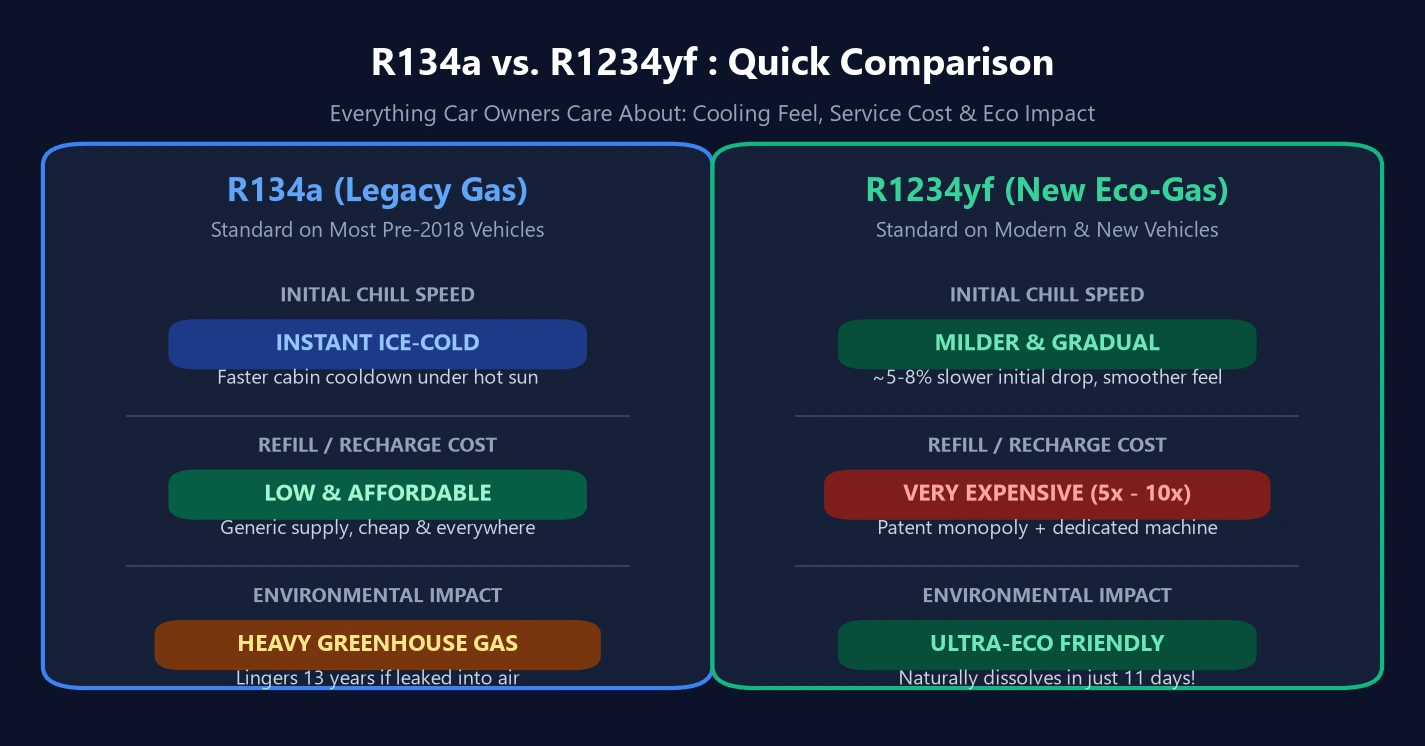
| Comparison Metric | Legacy: R134a | Modern: R1234yf | Real-World Impact at a Glance |
|---|---|---|---|
| Initial Cooling Feel | Instant chill, rapid temperature drop | Slightly milder (approx. \(5\% \sim 8\%\) slower initially) | Legacy fluid absorbs heat faster; modern systems use larger condensers to compensate, but feel less aggressive on scorching days. |
| Eco Impact (Why the Shift?) | Severe greenhouse gas (persists \(13\text{ years}\) in air) | Ultra-eco-friendly (dissolves in just \(11\text{ days}\)) | Banned by regulations; new gas has a lower global warming impact than carbon dioxide (\(\text{CO}_2\)). |
| Recharge Cost | Affordable and widespread | Expensive (\(5 \sim 10\times\) higher) | Patented synthesis by international chemical giants plus high raw material costs inflate service bills. |
| Workshop Equipment | Standard manifold gauges or generic machines | Requires spark-proof precision recovery stations | Mild flammability and high cost mandate expensive, dedicated shop equipment. |
2. Why Do Drivers Complain It “Cools Slower”?
The sensation that new cars don’t blast instant freezing air is not purely psychological. It stems from two physical realities:
- Thermodynamic Hurdle: Lower Latent Heat Automotive cooling relies on refrigerant liquid boiling into vapor within the evaporator to pull heat out of cabin air. R1234yf has a \(5\% \sim 8\%\) lower latent heat of vaporization than R134a. At identical compressor displacement and line velocity, it absorbs slightly less heat per unit of time.
- Automaker Compensations To offset this thermodynamic deficit, modern vehicles incorporate enlarged condenser surface areas, internal heat exchangers (IHX), and variable-displacement electronic compressors. While the cabin eventually achieves identical stabilized temperatures, that initial instant blast-chill punch feels less raw than old R134a systems.
3. Why Is It So Outrageously Expensive?
Two economic and technical drivers explain the price tag:
- Chemical Patent Monopolies R1234yf was co-developed and patented by US chemical titans Honeywell and Chemours (formerly DuPont). Strict patent barriers and intricate multi-step synthesis prevent generic competitors from driving down market prices.
- Dedicated Equipment & Safety Standards Because R1234yf carries an A2L mild flammability rating, regulations mandate dedicated, explosion-proof, precision-metered recovery and recharge machines. Repair shops must invest tens of thousands of dollars in specialized equipment, which is factored into service fees.
4. Three Essential A/C Maintenance Rules for Owners
- Check Your Engine Bay Label: Never Cross-Contaminate! Underhood radiator support brackets display a refrigerant placard. Never allow a shop to recharge an R1234yf system with cheap R134a. The expansion valves, pressure dynamics, and compressor oils differ (e.g., Denso uses ND-OIL 8 for R134a, but mandates specialized ND-OIL 12 for R1234yf, as discussed in our ND8 Compressor Oil Guide). Mixing fluids ruins oil solubility and burns out the compressor!
- Insist on Precision Gram-Weight Recharging Modern air conditioning systems are extremely sensitive to charge mass: being off by just \(30\text{ grams}\) compromises heat rejection and discharge temperature. Never use “sight-glass guesswork” charging; insist on computer-controlled, automated scale recharging matched to your vehicle’s exact gram rating.
- Refrigerant Does Not Naturally “Consume” Itself Air conditioning systems are hermetically sealed loops. If cooling performance drops after a few years, a micro-leak in an O-ring, condenser, or evaporator core has developed. Blindly injecting expensive R1234yf without locating and repairing the leak is simply throwing money into thin air.