Analysis of Fatal Flaws in Automotive Sodium-Ion Batteries (SIB): Voltage Limitations and High-Temperature Safety Hazards
In recent years, with the development of lithium battery technology, more and more car owners are choosing to upgrade their heavy, short-lived traditional lead-acid batteries to high-performance Lithium Iron Phosphate (LFP) starter batteries. However, new concepts like Sodium-Ion Batteries (SIB) have recently emerged in the market, claiming to replace LFP.
As an automotive starter battery, it must not only withstand instant discharge currents of hundreds of amperes but also endure high engine bay temperatures and comply with vehicle alternator voltage specifications. This article analyzes why Lithium Iron Phosphate (LFP) remains the optimal solution and top upgrade choice for automotive starter batteries from the perspectives of voltage matching, chemical stability, and high-temperature safety.
Core Issue: Alternator Charging Voltage
Most car and motorcycle alternators output approximately 13.5V to 14.4V during operation (used to supply power and float-charge 12V vehicle systems and lead-acid batteries). Under this standard, the battery’s series configuration and voltage matching determine whether it can function properly.
Sodium-Ion Battery (SIB) Series Configurations & Voltage Mapping
| Series Setup | Nominal / Cell Voltage Spec | Full Charge Voltage Demand | 14.4V Alternator Compatibility | Physical Result |
|---|---|---|---|---|
| 3 Series (3S) | 3.8V – 4.0V Cells | 11.4V – 12.0V | Alternator 13.5V~14.4V Constant Overcharge | Extremely Dangerous (Far exceeds 11.4V/12.0V limit, causing bloating & runaway) |
| 4 Series (4S) | 3.8V – 4.0V Cells | 15.2V – 16.0V | Each cell only receives 3.6V | Severely Undercharged (High-voltage region cannot be charged, usable capacity significantly reduced) |
Voltage Specification Source: HighStar Original Datasheet
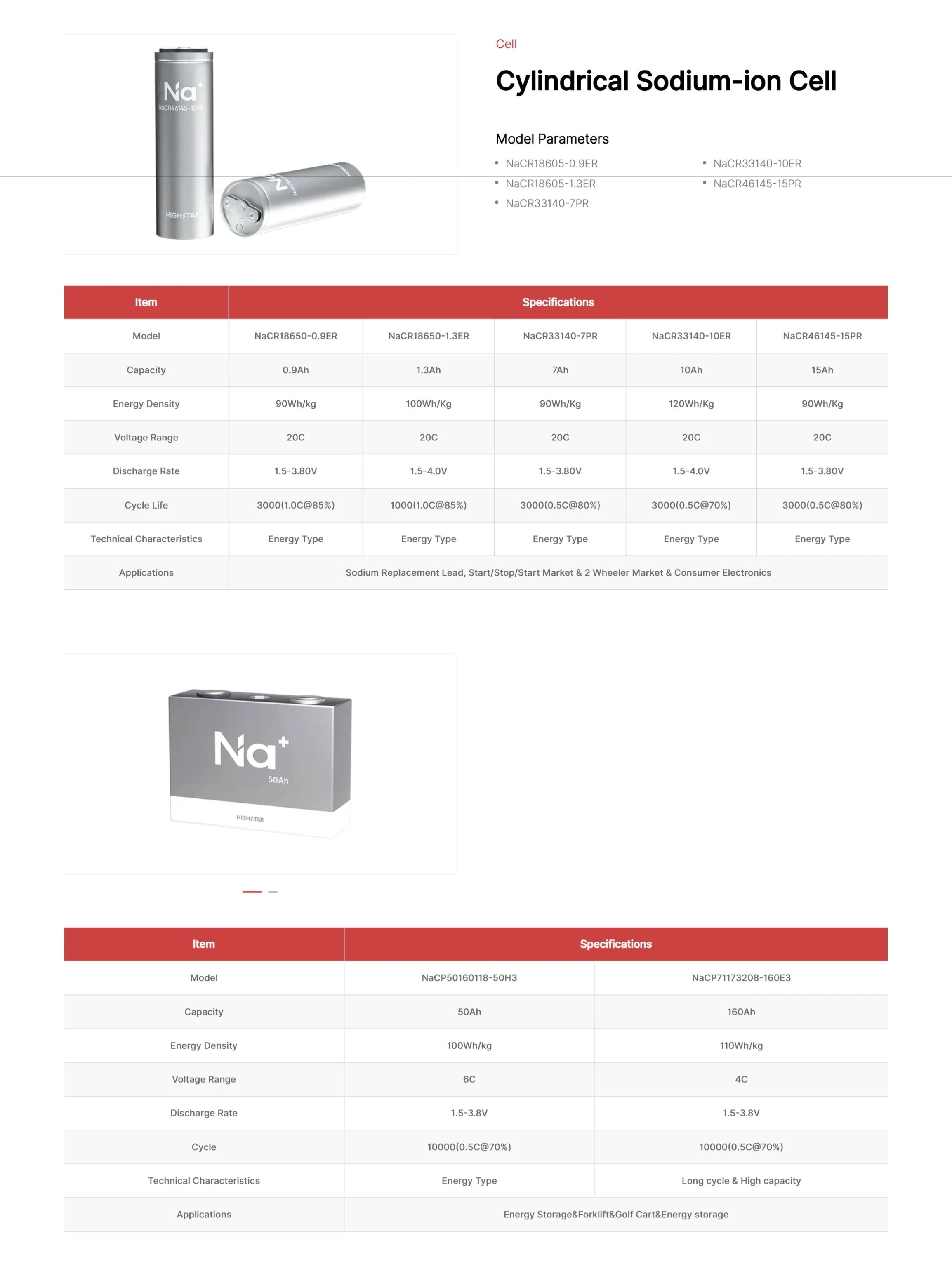
Fatal Flaw 1: Physical Barrier of Voltage Mismatch (3S Overcharged, 4S Undercharged)
Under the 13.5V to 14.4V output profile of automotive alternators, sodium-ion batteries face an extremely awkward voltage adaptation dilemma:
1. Why does 3 Series (3S) burn out from overcharging?
- The alternator outputs 13.5V–14.4V, which is far higher than the full charge limit of 11.4V–12.0V for a 3S sodium battery (3.8V–4.0V per cell).
- Once installed in a vehicle, the alternator will severely overcharge the battery continuously, easily triggering cell bloating, thermal runaway, or protection board shutdown.
2. Why is 4 Series (4S) severely undercharged with sudden voltage drops?
- The alternator outputs a maximum of only 14.4V, distributing to just 3.6V per cell across 4 cells (far below the 3.8V or 4.0V required for a full charge).
- Usable capacity significantly reduced: Sodium battery capacity is distributed along a slope with voltage; when charged to only 3.6V per cell, only about 60% to 70% of the capacity is charged. Without reaching the 3.8V–4.0V full charge threshold, the upper high-voltage capacity cannot be utilized, drastically reducing actual usable capacity.
- Discharging voltage continuously declines: LFP has an extremely flat discharge curve (maintaining >13V even with 20% remaining capacity); whereas sodium batteries have a very wide discharge window (1.5V–3.8V/4.0V), causing voltage to drop linearly as capacity depletes. When a 4S sodium battery drops below 11V (2.75V per cell), it easily causes the vehicle ECU to reboot or fail to start the engine properly.
Fatal Flaw 2: Violent Oxygen-Releasing Thermal Runaway and High-Temp Bloating
Automotive engine bays frequently reach temperatures of 70°C to 90°C during summer operation, posing a severe test to battery material thermal stability.
1. LFP (Lithium Iron Phosphate): Inherently Safe, No Oxygen Release
- Ultra-high thermal runaway threshold: The thermal runaway onset temperature is above 270°C, and the core crystal structure (\(PO_4\) phosphate) remains solid even up to 500°C.
- No oxygen release (Key Advantage): LFP releases almost no oxygen when decomposing under extreme heat or physical damage. Without an oxidizer/supporter of combustion, it is inherently extremely difficult to catch fire or explode.
2. Sodium-Ion Battery: Comparison of Three Cathode Material Routes and Inherent Limitations
The three main cathode material routes of current sodium-ion batteries (Layered Oxides NaxMO2, Prussian Blue Analogues PBA, and Polyanionic Compounds NFPP/NVPF) all face insurmountable disadvantages under high engine bay temperatures and 12V automotive starting demands:
| Property | Layered Oxides (Mainstream Commercial) | Prussian Blue / White | Polyanionic Compounds |
|---|---|---|---|
| Thermal Runaway Risk | High (Violent oxygen release fueling combustion) | Medium (High-temp gas generation & bloating) | Low (More stable structure) |
| Initial Decomposition Temp | Approx. 150–200°C | Higher (>250°C) | Higher (>250°C) |
| Volumetric Energy Density | High | Low | Low to Medium |
| Cycle Life | Medium (High-temp ion dissolution & degradation) | Low to Medium | Medium to High |
| Low-Temperature Tolerance (-20°C) | Medium | Good | Poor |
| Self-Discharge Rate | High (5–10%/month) Metal dissolution shuttle + Unstable hard carbon SEI |
Extremely High (>10%/month) Crystal water corrosion + Electrolyte decomposition |
Medium-Low (3–5%/month) No metal dissolution, only affected by hard carbon SEI repair |
| Summary | High energy, poor safety, acceptable low temp | Medium energy, medium safety, good low temp | Low energy, high safety, poor low temp |
Summary: Commercially available sodium batteries pursuing capacity and energy density mostly use Layered Oxides, but in hot engine bays (70–90°C), they are prone to thermal runaway, violently releasing oxygen to fuel combustion and causing bloating or leakage. Relatively safer Polyanionic Compounds, despite their thermal stability, suffer from extremely low volumetric energy density and voltage characteristics that severely mismatch 12V vehicle charging systems (facing the physical flaws where a 3S setup easily drops below 11V and a 4S setup cannot be fully charged). None of the three technical routes can currently be stably applied in automotive starter batteries.
Fatal Flaw 3: Lagging Volumetric Energy Density & High Self-Discharge Concerns
- Energy Density Disadvantage:
- LFP (Lithium Iron Phosphate): Volumetric energy density reaches 400–500 Wh/L (gravimetric energy density approx. 140–180 Wh/kg). Under the same physical dimensions, it provides larger capacity and higher cold cranking amps (CCA), weighing only 1/3 to 1/4 of traditional lead-acid batteries—making it the top choice for lightweighting.
- Sodium-Ion Battery: Volumetric energy density is only about 200–250 Wh/L. To achieve the same cranking current and actual capacity, both the volume and weight of a sodium battery increase significantly.
- Higher Self-Discharge Rate:
- Automotive-grade LFP cell technology is mature with extremely low self-discharge; the vehicle can still start smoothly after being parked for weeks or even months.
- Currently available commercial sodium cells have a higher self-discharge rate. If parked for an extended period, the battery is very likely to drain itself and fail to start the car.
Comparison of Common Starter Batteries (Taking LN3 Size as an Example)
| LN3 Size Comparison | Traditional Lead-Acid | Sodium-Ion Battery | Lithium Iron Phosphate (LFP) |
|---|---|---|---|
| Charge Rate & Usable Capacity | 100% Full Charge | Capacity Discounted (Cannot charge into high voltage at 14.4V) | Fully Chargeable (>95% Usable Capacity) |
| 14.4V Alternator Compatibility | Good | Poor (Cannot fully charge) | Good |
| Discharge Voltage Flatness | Acceptable | Poor (Slanted drop, easily drops below 11V when low) | Extremely High (Stays >13V even at 20% capacity) |
| Thermal Runaway & Safety | Good | Poor (Oxygen release fuels combustion) | Good (>270°C, inherently releases no oxygen) |
| Engine Bay High Temp Tolerance | Good | Poor (Prone to high temp bloating) | Good (Long cycle life at high temp) |
| Cycle Life | 500 – 1,000 cycles | 1,500 – 2,000 cycles | 4,000 – 6,000 cycles |
| Self-Discharge Rate | 5%–15%/month | 5%–10%/month | 1%–2%/month |
| Cell Quality Source | Standard automotive grade | Mostly second-tier minor factories | Top-tier lithium manufacturers |
Conclusion
Although sodium batteries show potential in low-temperature starting and raw material cost, they fall completely behind LFP in the core requirements of automotive starter batteries—voltage platform, safety, high-temperature stability, and volumetric efficiency.
If non-flammable solid-state electrolytes can be mass-produced in the future, sodium batteries might have a chance for a comeback. However, with current liquid electrolytes and 1.5V–4.0V discharge characteristics, putting a sodium battery into a scorching engine bay is equivalent to placing an experimental product that could fail at any time due to gas generation or insufficient voltage. Before modifying your battery, do not be misled by marketing slogans.