Advanced Engine Oil Parameters: The Truth About HTHS and VII Viscosity Improver Shear Down
In our previous discussion on oil parameters, we highlighted that HTHS dictates the tradeoff between fuel economy and high-RPM protection, and that VI (Viscosity Index) alone is not a reliable quality indicator.
Many car owners still wonder: why do two bottles labeled 5W-30 drive completely differently? And why do some hyped oils feel buttery smooth for the first \(2000\) km, only to become noisy and sluggish after \(3000\) km? The answers lie in two key metrics: HTHS and VII.
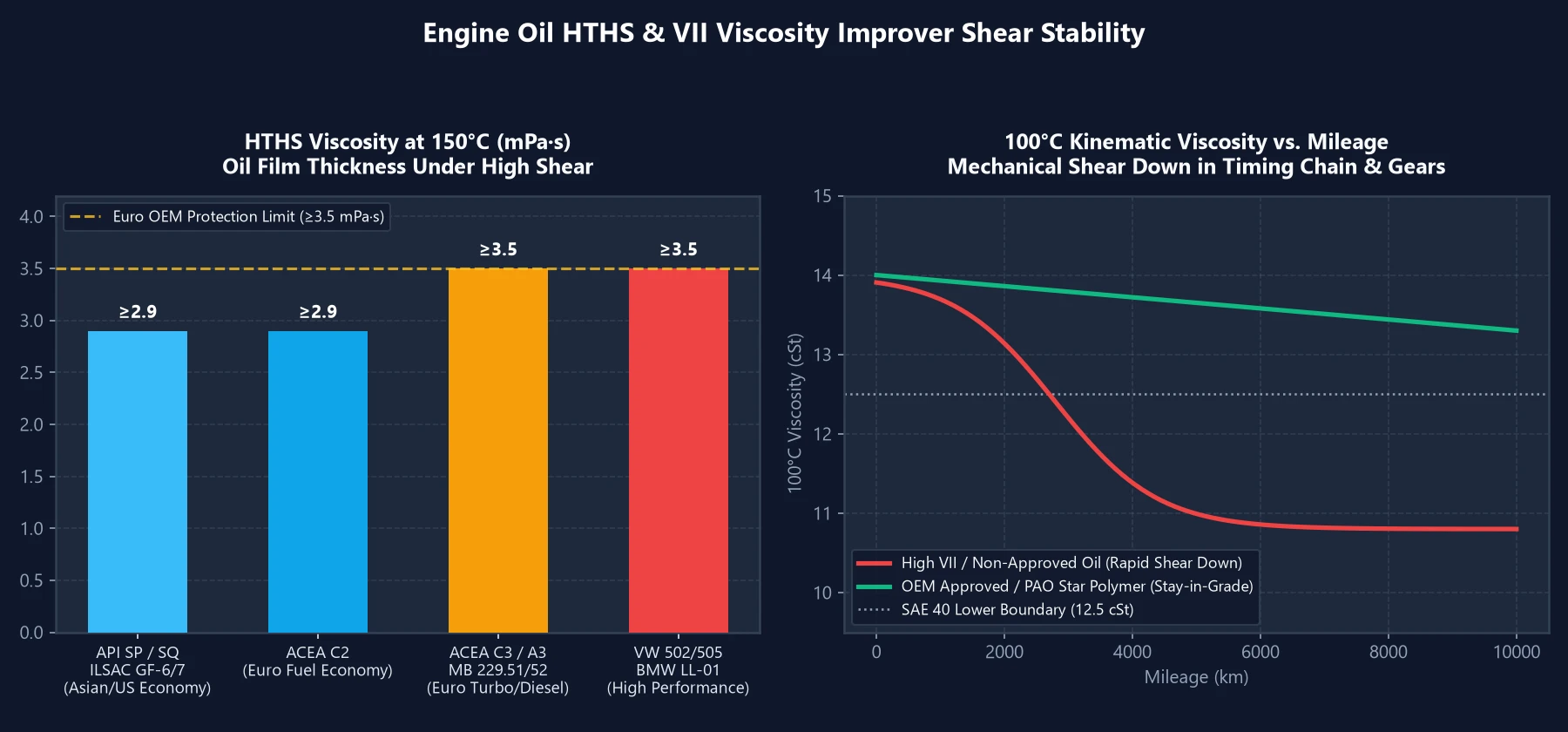
1. HTHS Viscosity: The Real Metric of Oil Film Strength
The 5W-30 rating on the bottle only describes kinematic viscosity measured at \(100^\circ\text{C}\). But under intense driving, temperatures between the piston ring and cylinder wall spike to \(150^\circ\text{C}\), where the lubricant experiences millions of shear cycles per second.
HTHS (High Temperature High Shear) measures true dynamic oil film thickness at \(150^\circ\text{C}\) under extreme shear stress (expressed in \(\text{mPa}\cdot\text{s}\) or \(\text{cP}\)). This single parameter divides 5W-30 into two distinct categories:
| 5W-30 Category | HTHS Specification | Typical Approvals | Characteristics & Best Fit |
|---|---|---|---|
| Low HTHS (Thin Film・Fuel Economy) |
\(2.9 \sim 3.1\) | API SP / SQ, ILSAC GF-6 / GF-7 ACEA A5/B5, ACEA C2 |
Responsive throttle, free-revving, highest fuel economy. Ideal for Asian, American, and Hybrid vehicles. |
| High HTHS (Thick Film・Protection) |
\(\ge 3.5\) | ACEA A3/B4, ACEA C3 MB 229.5 / 229.51 / 229.52 BMW LL-01 / LL-04, VW 504/507 |
Tough hydrodynamic cushion, superior wear defense. Essential for European turbo, diesel, and performance engines. |
Important Application Rule: Putting an
ACEA C3oil (\(\text{HTHS} \ge 3.5\)) into an Asian naturally aspirated commuter car won’t cause damage, but you will notice heavier throttle response and higher fuel consumption. Conversely, running anAPI SP / ILSAC GF-6oil (\(\text{HTHS} \approx 2.9\)) in a European turbo engine requiring \(\text{HTHS} \ge 3.5\) will lead to accelerated camshaft and cylinder wall wear under sustained boost!
2. VII (Viscosity Index Improvers): Why Oils Degrade at 3,000 km
To formulate multigrade oils like 5W-30 or 0W-40, blenders start with a thin base oil (to meet cold-cranking specs) and blend in VII polymers (coiled molecular spring chains):
- Cold temperatures: Polymer chains curl into tight coils, allowing smooth cold flow.
- High temperatures: The chains expand and interlock like a mesh, artificially thickening the thin base oil to achieve a 30 or 40 grade.
What Is “Mechanical Shear Down”?
As engine oil circulates through timing chains, oil pump gears, camshafts, and piston rings, these expanded polymer chains get physically sliced apart like scissors cutting string!
- Budget / Inflated Oils (Inferior base oil + excess cheap VII): To achieve inflated VI figures (\(\text{VI} > 190\)), blenders load cheap linear polymers. The oil starts quiet, but within \(3000\sim 5000\) km the polymer chains are sheared to pieces. The oil collapses back into thin base oil, causing drastic drops in HTHS and viscosity—the real culprit behind engine harshness.
- OEM-Approved Synthetic Oils (PAO/GTL base + star polymers): Premium certified oils rely on high-grade PAO / GTL synthetic bases that naturally resist thinning, minimizing VII dependency, and utilize resilient “Star Polymers” that maintain viscosity integrity beyond \(10000\) km.
3. Three Practical Rules for Choosing Engine Oil
- Identify Your Vehicle’s “HTHS Camp” First:
- Asian/US/Hybrid cars: Choose low-drag fuel economy oils matching
API SQ / SP,ILSAC GF-7 / GF-6, orACEA C2(\(\text{HTHS} \approx 2.9\)). - European Turbo/Diesel engines: Mandate robust protection matching
ACEA C3orA3/B4(\(\text{HTHS} \ge 3.5\)).
- Asian/US/Hybrid cars: Choose low-drag fuel economy oils matching
- Insist on Genuine “OEM Approvals” to Prevent Shear Breakdown:
Oils officially approved under standards like
MB 229.5 / 229.51 / 229.52,VW 504/507,BMW LL-04, orPorsche A40must pass brutal high-pressure injector Stay-in-Grade shear tests, ensuring consistent protection throughout the service interval. - Do Not Chase Unrealistically High “Viscosity Index (VI)”:
Standard high-quality
5W-30oils feature VI values between \(160 \sim 175\). Any uncertified brand advertising \(\text{VI} > 190\) or \(200+\) typically relies on volatile thickeners that break down rapidly.