New Tires vs. Old Stock: Are DOT Manufacturing Date Codes Really a Safety Indicator?
When buying replacement tires, many car owners instinctively crouch down to inspect the DOT production date code on the sidewall. If it was made just three months ago, they feel like they scored; but if it was produced one or two years prior as “new old stock,” they immediately suspect the dealer is offloading hardened, degraded inventory.
Treating automotive tires like fresh dairy milk, however, contradicts automotive physics. Does a 1- or 2-year-old properly stored tire actually compromise safety? Here is the truth backed by international testing data.
1. How to Read a Tire Manufacturing Date (DOT Code) in 10 Seconds
On the outer sidewall, locate the sequence beginning with DOT. The last 4-digit number inside the oval stamp reveals the production batch:
| Stamp Example | Breakdown | Meaning |
|---|---|---|
3525 |
First two digits 35 (week) + Last two digits 25 (year) |
Manufactured in the 35th week of 2025 (late August 2025) |
0826 |
First two digits 08 (week) + Last two digits 26 (year) |
Manufactured in the 8th week of 2026 (late February 2026) |
2. Scientific Testing: Does 1- to 3-Year-Old Stored Inventory Lose Performance?
Independent automotive bodies and major tire manufacturers have conducted rigorous blind testing:
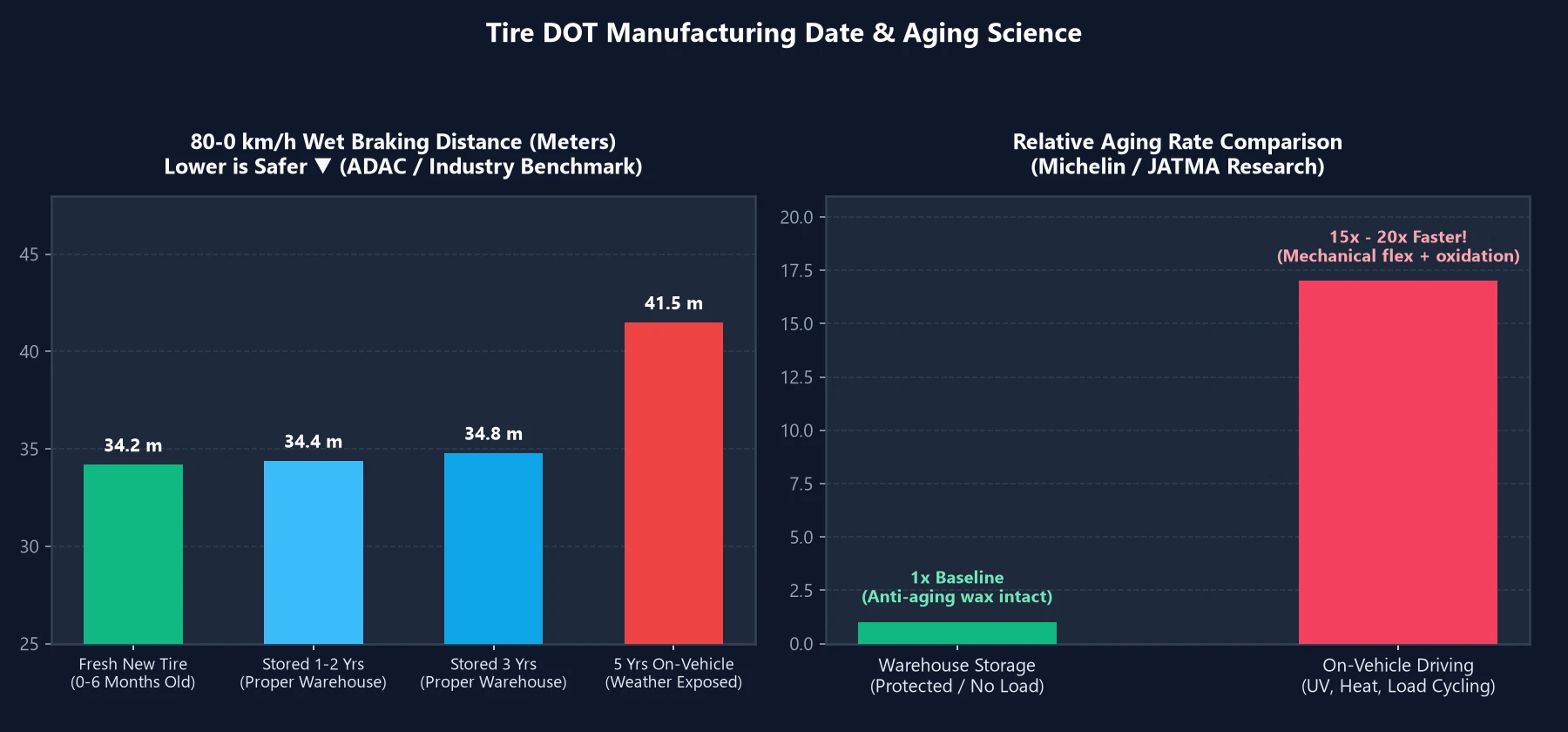
- German Automobile Club (ADAC) & Korea Consumer Agency (KCA): Compared freshly manufactured tires directly against unused \(2\text{ to }3\text{-year-old}\) stored stock. On high-speed stability tracks, wet ABS emergency braking, and hydroplaning tests, wet braking distances and cornering grip were statistically indistinguishable.
- Saudi Standards Organization (SASO) & Japan JATMA: Found that driving on tires for just \(3\text{ weeks}\) inflicts equivalent oxidative stress and thermal aging as sitting undisturbed in a warehouse for \(1\text{ full year}\)!
- Michelin & Bridgestone Research: Unused tires stored in standardized indoor conditions age at only \(\frac{1}{15}\text{ to }\frac{1}{20}\) the speed of mounted, active tires. Furthermore, rubber vulcanization cross-linking (curing) continues to stabilize over several months post-production; slightly aged stock tires can often demonstrate superior treadwear endurance.
Why Don’t Unused Tires Degrade on the Shelf? Every tire compound contains active anti-ozonants and protective waxes. When standing in a warehouse, these waxes migrate to the surface, forming a grayish-brown protective glaze that blocks atmospheric oxygen and ozone. Without vehicle tonnage, sunlight UV rays, and asphalt heat cycles, chemical degradation remains negligible.
3. How to Choose Smartly: Fresh Stock vs. Discounted Year-Old Stock
Understanding rubber aging allows you to choose based on your annual driving mileage:
| Driver Category | Annual Mileage | Smartest Choice | Strategic Rationale |
|---|---|---|---|
| High-Mileage Commuters | \(> 15,000\text{ km / year}\) | 1- to 2-Year-Old Stock (Best Value!) |
You will wear down the tread within \(2 \sim 3\text{ years}\), well before calendar aging becomes a factor. Buying discounted year-old stock saves significant cash without safety compromises. |
| Low-Mileage / Weekend Drivers | \(< 5,000\text{ km / year}\) | Current-Year Fresh Tires | Because your tread will outlive the rubber compound, purchasing tires with the freshest DOT date maximizes your usable on-vehicle years before reaching time-based retirement. |
4. The “3 / 5 / 10 Golden Rule” of Tire Replacement
- Under 3 Years Old (Unmounted) = Sold as Factory-New: Under German DIN standards and European regulations, tires stored properly for up to \(3\text{ years}\) are legally categorized as brand-new (“fabrikneu”).
- 5 Years on the Car = Annual Professional Inspection: Once mounted and driven for \(5\text{ years}\), tires must be inspected annually for sidewall micro-cracking and tread groove hardening, regardless of tread depth.
- 10 Years from DOT Date = Mandatory Retirement: When \(10\text{ years}\) have elapsed from the stamped DOT date (including full-size spares), the tire must be retired unconditionally to eliminate high-speed blowout risks.