No Car Brand Logo Means Aftermarket? Debunking the Genuine, OEM, and Aftermarket Myths for Car Parts and Tires
Many car owners experience this scenario: after replacing a battery or component at an independent garage, they take their car to the dealership for routine service only to be told, “That part is aftermarket.” This often leaves drivers wondering whether they were misled by the independent shop.
What exactly defines a “Genuine Part”? Does the absence of an automaker’s logo always mean an inferior “Aftermarket Part”? And why is the term “aftermarket tire” virtually unheard of when shopping for tires? This article clarifies the distinctions between automotive parts and tires across the supply chain.
1. Automotive Parts: Trademarks, Distribution Channels, and Perception
To understand the authenticity and tiers of auto parts, one must first recognize an industry reality: automakers do not manufacture most of their own components.
Between 70% and 80% of components on a modern vehicle (such as spark plugs, alternators, shock absorbers, brake systems, and batteries) are engineered and produced by specialized global tier-1 suppliers like Bosch, Continental, ZF Sachs, and VARTA.
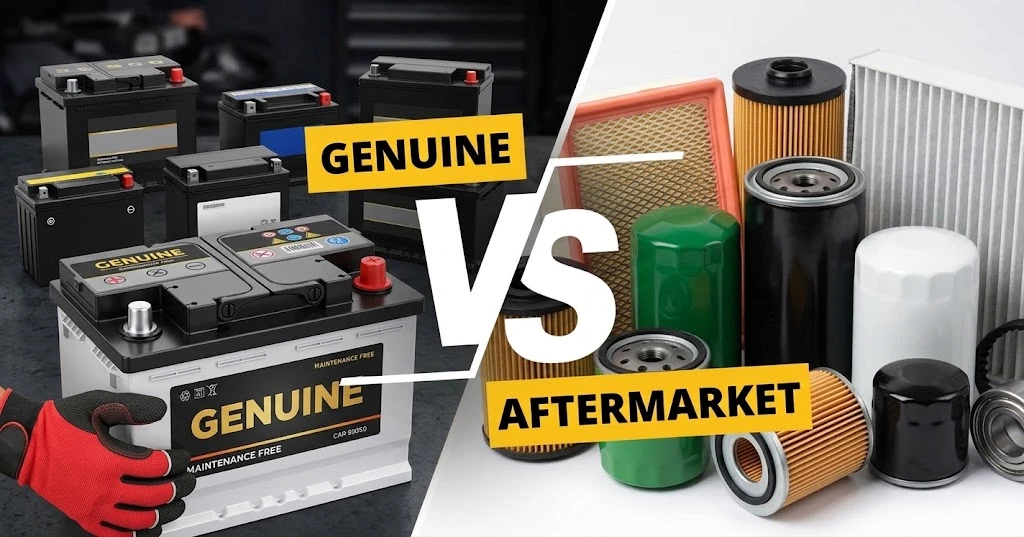
In the automotive parts market, components generally fall into three tiers:
1. Genuine Parts
- Definition: Manufactured by tier-1 suppliers, inspected by the automaker, stamped with the automaker’s brand logo and official part number, and packaged in official automaker boxing.
- Characteristics: Available exclusively through authorized dealerships and official distribution networks. They carry the highest price (reflecting brand licensing fees and corporate overhead) and include official manufacturer warranties.
2. OEM Parts (Original Equipment Manufacturer Equivalent)
- Definition: Produced by the exact same tier-1 manufacturer that supplies the automaker, offering comparable quality to genuine parts, but packaged under the supplier’s own brand name.
- Characteristics: Distributed through general automotive parts channels at roughly 50% to 70% of the genuine part’s price.
3. Aftermarket Parts (AM Parts)
- Definition: Replacement components designed and manufactured by third-party factories that are not original suppliers to the automaker, built to compatible specifications.
- Characteristics: Most affordable, though quality, tolerances, and durability can vary widely depending on the brand’s reputation.
2. The Unique Case of Tires: Why Are There No “Aftermarket Tires”?
When it comes to tires, the paradigm changes completely—no one refers to Michelin, Continental, or Bridgestone tires as ‘aftermarket tires’.
Tires are standardized consumable components, and major tire manufacturers possess standalone brand prestige and R&D capabilities that rival automakers. In the tire market, products are categorized into the following tiers:
1. Original Equipment (OE Tires)
The tires factory-fitted on a brand-new vehicle. During vehicle development, automakers partner with tire brands to source specific models aligned with the vehicle’s design targets.
2. Automaker Marked / Certified Tires
For luxury or performance vehicles (such as Porsche, BMW, Mercedes-Benz), tire makers collaborate with vehicle engineering teams to fine-tune tread compounds, internal structure, and noise dampening, stamping a homologation marking directly on the sidewall:
★(Star): BMW / Mini HomologatedMO/MOE: Mercedes-Benz Approved (MOE denotes Extended Mobility / Run-flat)AO/RO1: Audi Approved (RO1 designates RS high-performance models)N0~N6/NA0: Porsche ApprovedT0/T1: Tesla Approved (often equipped with acoustic foam liners)
3. Universal Replacement Tires
Standard replacement tires offered to the broad retail market. As long as the tire dimensions (e.g., 225/45 R17), load index, and speed rating match the vehicle’s manual, they can be freely installed with full legal compliance and safety.
3. Comprehensive Summary: Parts vs. Tires
The table below outlines the core differences between vehicle components and tires:
| Dimension | Auto Parts: Genuine Parts | Auto Parts: OEM / Aftermarket Parts | Tires: OE / Marked Tires (Certified) | Tires: Universal Replacement Tires |
|---|---|---|---|---|
| Core Definition | Packaged, approved, and warrantied by the automaker. | Parts lacking an automaker logo (covering OEM and third-party aftermarket). | Factory-fitted or specially tuned and tested by the automaker. | Standard production tires released by tire manufacturers for the open market. |
| Appearance & Markings | Features automaker logo and official part number. | Features supplier/brand label, without automaker logo. | Displays tire brand alongside automaker certification code (e.g., MO, ★). |
Displays tire brand and universal specs (e.g., 205/55 R16) only. |
| Distribution Channels | Authorized dealer networks and franchised parts suppliers. | Independent repair shops, auto parts retailers, online distributors. | Dealerships, tire specialists, automotive service chains. | Tire specialists, independent repair shops, automotive retail chains. |
| Warranty & Liability | Covered under automaker warranty; clear claims process. | Not warrantied by automaker; backed by repair shop or part manufacturer. | Warrantied by tire manufacturer; does not impact overall vehicle warranty. | Warrantied by tire manufacturer; compliant specs do not affect vehicle warranty. |
| Pricing | Highest (includes brand licensing and dealer network markup). | Budget to Moderate (typically 30% to 70% of genuine pricing). | Moderate to High (often slightly higher than universal equivalents). | Flexible (ranging from economy to ultra-high-performance). |
| Common Terminology | “Genuine parts”, “Dealer parts”, “OE parts”. | “Aftermarket”, “OEM replacement”, “Independent shop parts”. | “Factory-fitted tires”, “Homologated tires”, “Star / MO marked tires”. | “Universal tires”, “Replacement tires”, “Retail spec tires”. |
Conclusion: Smart Buying Guidelines
Understanding the distinction between parts and tires allows owners to make practical maintenance decisions:
- Under New Car Warranty: For major powertrain assemblies and critical electronic modules (such as engine ECUs, transmission components, and driveline units), choosing Genuine Parts installed through authorized channels ensures warranty claims remain dispute-free.
- Post-Warranty or Routine Wear Items: For regular consumables such as batteries, brake pads, filters, and spark plugs, reputable OEM Parts deliver identical performance to genuine parts while substantially reducing maintenance costs.
- When Replacing Tires: Choosing well-established brands (Michelin, Continental, Bridgestone, Goodyear, etc.) that match owner manual specifications is perfectly sufficient for daily driving. For high-performance sports cars with sensitive suspension dynamics, selecting automaker-marked homologated tires remains the ideal choice.