How to Read a Simple Battery Internal Resistance Tester: Debunking CCA & Baseline Myths
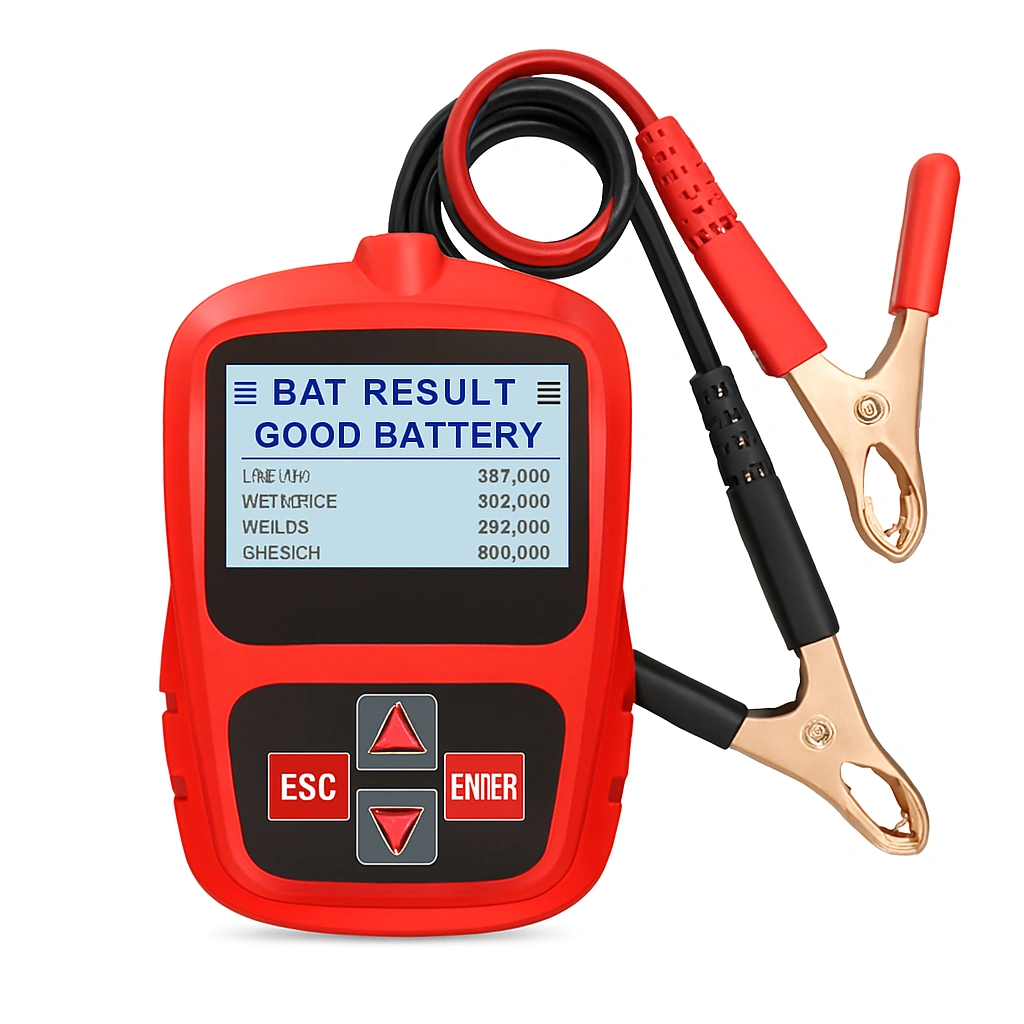
Many people judge a car battery by the CCA and State of Health (SOH) shown on a handheld internal resistance tester, yet those numbers are mostly “estimates.” Once you understand the logic and boundaries built around traditional lead-acid batteries, you can read the data accurately (for why CCA testing does not apply to lithium batteries, see Why Measuring CCA for Lithium Batteries is Meaningless).
1. What Does a Simple Internal Resistance Tester Actually Measure?
These electronic testers do not run a high-current load discharge of hundreds of amps; they actually only measure static voltage (V) and internal resistance (mΩ) using a weak signal (AC conductance or a small pulse).
On traditional lead-acid batteries, SOC (%) is primarily estimated from static voltage, while Estimated CCA and SOH (%) are calculated from internal resistance using empirical formulas (much like a body-fat scale). This makes the tool great for quick screening and long-term trend tracking, rather than a true load-test result. Once you leave lead-acid chemistry, that CCA estimation no longer holds.
2. Does the Baseline Setting Make a Difference?
Under the same test standard (such as CCA) and battery type, adjusting the baseline value does not change the measured internal resistance (mΩ) or estimated CCA; it only changes the SOH percentage and the Good/Replace verdict on screen:
\[\text{SOH (\%)} \approx \frac{\text{Estimated CCA}}{\text{Entered Baseline}} \times 100\%\]Exact formulas vary by brand (some use a linear ratio, some use a squared ratio like \((400/500)^2 = 64\%\), and most cap at 100%; switching test standards or Flooded/AGM battery types can alter calculated values on some models). What matters is not whether you set 400 or 500, but keeping the setting fixed to track changes.
3. Why Do Readings on the Same Battery Vary?
Consumer testers have hardware tolerances, and four conditions noticeably shift readings:
- Just Driven or Just Charged: Surface charge and heat often make SOC look optimistic and resistance look lower; right after charging, polarization and micro-bubbles can cause resistance to drift.
- Low State of Charge (Below ~12.4V–12.5V): Insufficient charge (higher threshold for AGM) temporarily raises internal resistance, making it easy to misjudge an undercharged battery as dead.
- Different Ambient Temperatures: Chemical reactions are temperature-sensitive, so summer and winter readings will differ noticeably.
- Contact Resistance: Clamp cleanliness and how firmly the jaws grip the lead posts directly affect the
mΩreading.
4. Does High Internal Resistance Mean a Poor Battery?
Not necessarily (Note: applies only to lead-acid batteries; CCA interpretation is completely inapplicable to non-lead-acid batteries). Resistance gaps between same-spec brands usually reflect design and storage trade-offs:
- Plates & Electrolyte Gravity: More, thinner plates or higher acid gravity boost rated output, though thinner plates degrade faster under heat and overly high gravity accelerates grid corrosion. Thicker plates start slightly higher in resistance but often last more steadily.
- Shelf Freshness: A freshly built battery and one stored for months naturally differ in baseline resistance.
Thus, comparing resistance directly across brands is meaningless; always weigh suspiciously low weight or abnormal voltage as well.
5. How to Measure for Maximum Reference Value
- Test Fully Charged and Rested: Ensure a fully charged, rested state (~
12.6V+for standard lead-acid, ~12.8V+for AGM; at least above12.5Vbefore testing). - Clamp Directly onto the Battery Posts: Avoid mounting bolts and harnesses. 4-wire Kelvin clamps eliminate wire and clamp-tip contact resistance, but cannot eliminate oxidation or transition resistance between the lead post and terminal clamp.
- Compare Against Its Own New Baseline: First compare against the baseline recorded when that battery was brand-new (fully charged and rested); if unavailable, refer to the new-unit reference range for the same brand and model.
- Stick to the Same Tester: Different brands use different algorithms; using the same unit over time gives the cleanest resistance trend.
Conclusion
The real value of a simple internal resistance tester is not a one-off CCA or SOH number, but tracking the internal resistance trend of the same battery over time when fully charged and rested. For lead-acid batteries, watching the resistance trend is far more meaningful than obsessing over percentages (on why CCA fails on lithium batteries, see Why Measuring CCA for Lithium Batteries is Meaningless).