Decode Japanese Car Battery Codes in Seconds! Complete Guide to JIS Specifications & Performance Ranks
When shopping for or replacing a Japanese car battery, you will frequently encounter alphanumeric codes such as 80B24L or 55D23L. While they might appear perplexing at first glance, these designations strictly follow the Japanese Industrial Standard (JIS D 5301). Every character precisely describes the battery’s electrical capability and physical packaging dimensions. Here is a comprehensive breakdown of what every character in a Japanese automotive battery code signifies.
1. Deconstructing Japanese Battery Model Numbers: The “80B24L” Example
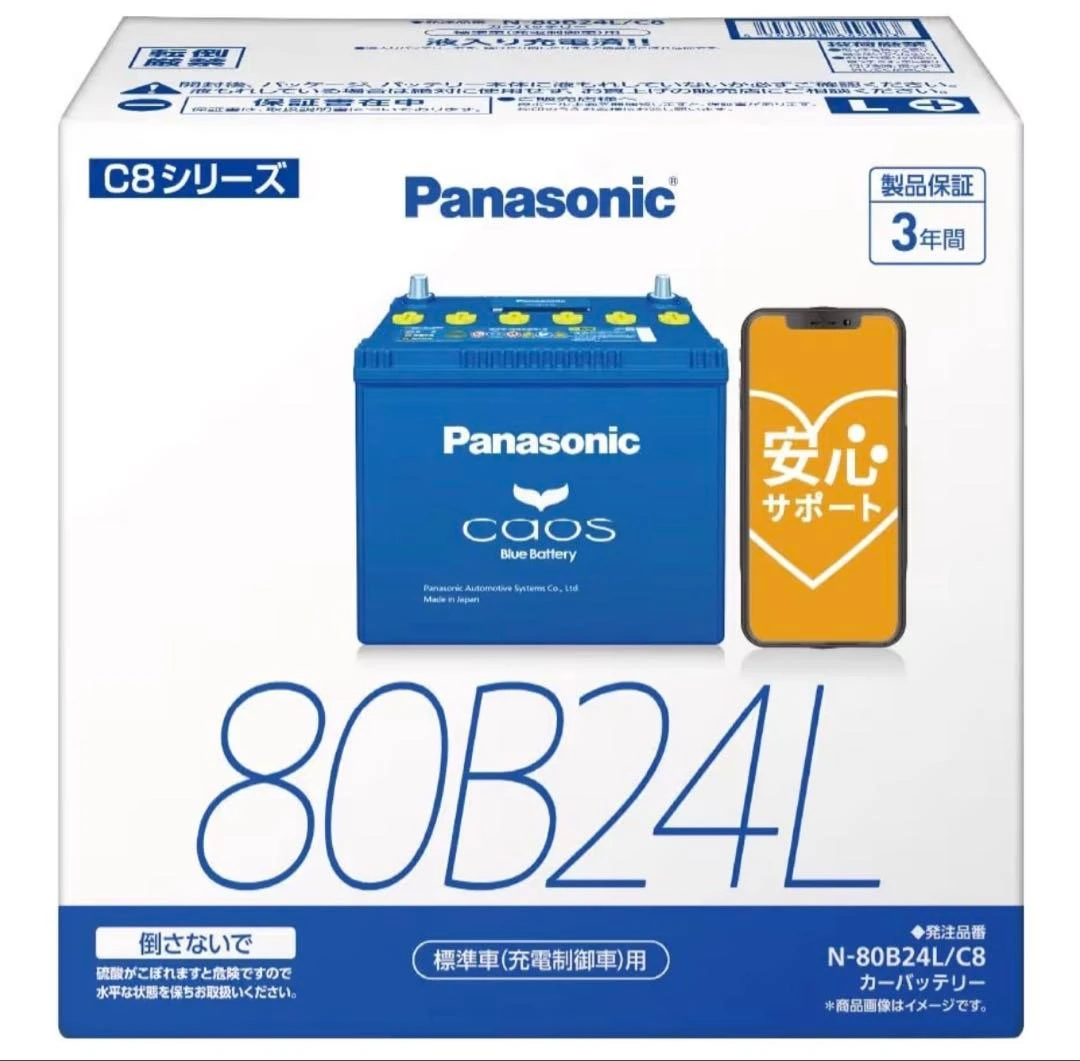
The JIS specification standardizes battery model designations into four key segments:
| Example Mark | Designation | Meaning & Technical Explanation |
|---|---|---|
| 80 | Performance Rank | Higher numbers indicate greater cranking performance and electrical capacity. |
| B | Width & Height Code | Specifies the standardized cross-sectional dimensions (width and height). |
| 24 | Case Length | Represents an approximate length of 24 cm (\(240\text{ mm}\)). |
| L | Positive Terminal Position | Indicates the positive terminal is on the Left side. |
In-Depth Breakdown of Each Segment
- Performance Rank (e.g., 80)
- This is a composite rating evaluating the battery’s overall electrical output and starting capability. A larger number indicates superior reserve capacity and cranking vigor.
- When replacing a battery, car owners may select the stock rating or upgrade to a higher number (for instance, stepping up from 46 to 60 or 80) to enjoy stronger reserve stability and smoother engine crank cycles.
- Casing Profile Code (e.g., B)
- English letters represent standardized width and height cross-sectional profiles:
- B: Width approx. \(129\text{ mm}\), height approx. \(203\text{ mm}\).
- D: Width approx. \(173\text{ mm}\), height approx. \(204\text{ mm}\).
- Caution: This letter directly dictates whether the battery can fit securely into your engine compartment’s battery tray and under the factory mounting bracket. It must never be altered arbitrarily.
- English letters represent standardized width and height cross-sectional profiles:
- Case Length (e.g., 24)
- Denotes the approximate longitudinal outer length of the battery casing in centimeters (24 cm / \(240\text{ mm}\)).
- Because engine bay trays have fixed boundaries, the length must match the vehicle’s bracket tray dimensions.
- Terminal Polarity Orientation (e.g., L or R)
- Perspective rule: Face the battery from the front, with the terminal posts closest to your chest:
- L (Left): The positive (+) terminal is on the left side.
- R (Right): The positive (+) terminal is on the right side.
- Crucial Warning: Factory battery cables are engineered with minimal slack. If you purchase the wrong polarity orientation, the cables cannot cross over to reach the opposite posts, preventing installation entirely. Always verify whether your car requires an L or R layout before buying.
- Perspective rule: Face the battery from the front, with the terminal posts closest to your chest:
2. Advanced Technical Knowledge: How Is the Performance Rank Calculated?
Under the JIS D 5301 standard, the leading performance rank (such as 50 or 80) is not an arbitrary marketing label. It is mathematically calculated using the following formula and rounded to the nearest integer:
\[\text{Performance Rank} = \sqrt{\text{CCA} \times \text{RC} \times 0.28}\]The formula incorporates two foundational battery metrics: CCA and RC:
- Cold Cranking Amperes (CCA):
- Definition: The maximum discharge current a battery can supply at \(0^\circ\text{F}\) (approx. \(-17.8^\circ\text{C}\)) under extreme cold conditions while maintaining a functional cutoff voltage.
- Significance: Reflects cold starting punch. Higher CCA ensures quick, confident engine turnover during severe winters or cold engine starts.
- Reserve Capacity (RC):
- Definition: The number of minutes a battery can continuously discharge a constant \(25\text{ A}\) current at \(25^\circ\text{C}\) before its terminal voltage drops to \(10.5\text{ V}\).
- Significance: Reflects emergency endurance—how long the vehicle can sustain essential electrical systems if the alternator fails or when operating accessories with the engine shut off.
3. Practical Buying and Replacement Guidelines
- Physical Dimensions Must Match Exactly (Letter + Length): Standards like
B24orD23are non-negotiable mounting requirements; incorrect dimensions will not fit the factory tray or bracket. - Never Get Terminal Polarity Wrong (L vs. R): Pop the hood and inspect your existing battery’s terminal layout prior to ordering.
- Performance Ranks Can Safely Be Upgraded: If your car is equipped with dashcams, high-end audio setups, digital mirrors, or other power-hungry accessories, choosing a higher performance rank within the same form factor (e.g., upgrading from
46B24Lto80B24L) provides significantly superior endurance and reliability.