Brake Fluid Specifications Explained: DOT 3 vs. DOT 4 vs. DOT 4 LV vs. 5.1 & Maintenance Guide
When servicing your car, you will often see labels like DOT 3, DOT 4, DOT 4 LV, or DOT 5.1 on brake fluid bottles. Does a higher number always mean better performance? And why do mechanics insist on changing brake fluid every 2 years even if you barely drive? Here is the simplest guide to understanding brake fluid specs and safety.
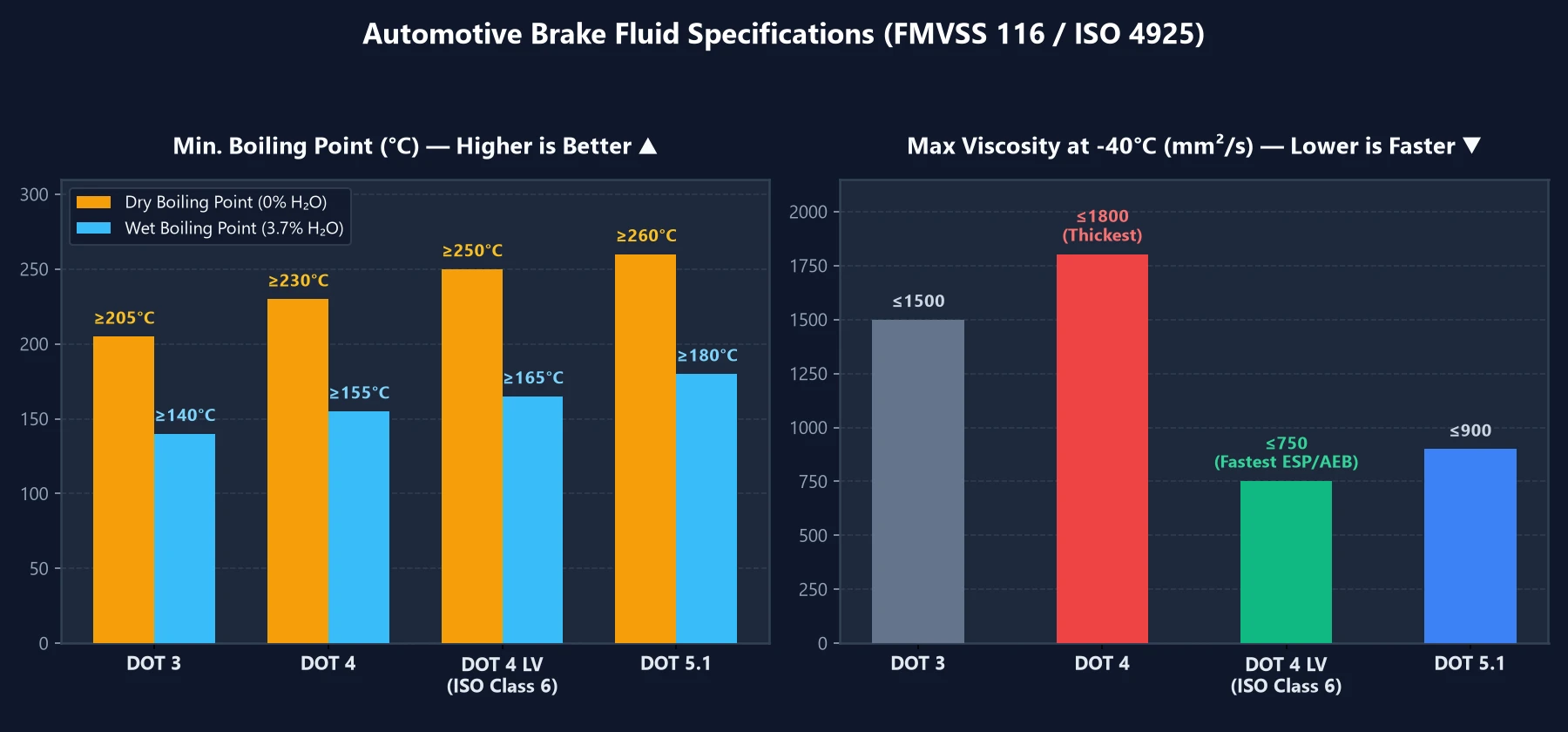
1. Brake Fluid Comparison Chart: The 3 Key Metrics
When choosing brake fluid, focus on three core numbers:
- Dry Boiling Point: The maximum temperature threshold of fresh, unopened fluid (\(0\%\) water content).
- Wet Boiling Point: The boiling point after roughly 1 to 2 years of service (\(3.7\%\) water content)—this is the true real-world safety metric.
- Low-Temperature Kinematic Viscosity: Lower numbers mean faster fluid flow and quicker ABS / ESP / AEB activation.
| Specification | Dry Boiling Point (Fresh) | Wet Boiling Point (3.7% Water) | Max Viscosity at \(-40^\circ\text{C}\) | Characteristics & Applications |
|---|---|---|---|---|
| DOT 3 | \(\ge 205^\circ\text{C}\) | \(\ge 140^\circ\text{C}\) | \(\le 1500\text{ mm}^2/\text{s}\) | Common in older Asian/domestic commuter cars; absorbs moisture slower but has a lower boiling point. |
| DOT 4 | \(\ge 230^\circ\text{C}\) | \(\ge 155^\circ\text{C}\) | \(\le 1800\text{ mm}^2/\text{s}\) | Higher boiling point than DOT 3, but actually thicker at low temperatures. |
| DOT 4 LV (Class 6) |
\(\ge 250^\circ\text{C}\) | \(\ge 165^\circ\text{C}\) | \(\le 750\text{ mm}^2/\text{s}\) | Best modern choice! High boiling point + ultra-fast flow; essential for cars with ESP/AEB. |
| DOT 5.1 | \(\ge 260^\circ\text{C}\) | \(\ge 180^\circ\text{C}\) | \(\le 900\text{ mm}^2/\text{s}\) | High-performance street fluid; ideal for spirited mountain driving or heavy loads. |
| DOT 5 | \(\ge 260^\circ\text{C}\) | (Non-hygroscopic) | \(\le 900\text{ mm}^2/\text{s}\) | Silicone-based (military/classic storage only); strictly forbidden in road cars with ABS! |
Why is
DOT 4 LV(ISO 4925 Class 6) the top recommendation today? While standardDOT 4handles higher temperatures thanDOT 3, it is noticeably thicker. Modern cars feature ESP (Electronic Stability Program) and AEB (Autonomous Emergency Braking), which must pump fluid through tiny ABS solenoid valves in milliseconds. Upgrading to low-viscosityDOT 4 LVdramatically speeds up hydraulic pressure build-up during emergencies!
2. Why Must Brake Fluid Be Replaced Regularly? Understanding “Vapor Lock”
Many drivers wonder: “Isn’t the brake system sealed? How does water get inside?”
In reality, atmospheric humidity permeates 24/7 through the microscopic pores of the four rubber brake hoses and caliper seals. Standard brake fluids (DOT 3 / 4 / 5.1) are intentionally engineered to be hygroscopic (water-absorbing):
- Why is it designed to absorb water? If brake fluid repelled water (like silicone DOT 5), any moisture entering the lines would sink to the lowest, hottest point—the brake calipers—and pool into free water droplets. Those droplets would flash-boil at just \(100^\circ\text{C}\) and corrode the caliper pistons and ABS valves from the inside. By dissolving moisture evenly throughout the fluid, glycol brake fluid prevents localized \(100^\circ\text{C}\) boiling, at the cost of a gradually declining overall boiling point.
What Is “Vapor Lock”?
- Normal State (Liquids Are Incompressible): When you press the brake pedal, liquid brake fluid transmits \(100\%\) of your foot’s hydraulic force directly to the caliper pistons.
- Failure State (Gases Are Compressible): When old brake fluid (over \(3\%\) water content, boiling point dropped to around \(140^\circ\text{C}\)) is subjected to continuous braking on a long mountain descent, intense heat from the pads and rotors causes the fluid inside the caliper to boil and form vapor bubbles. Because gas bubbles are compressible, pressing the brake pedal simply squeezes the bubbles instead of pushing the caliper pistons—causing the pedal to sink straight to the floor with total brake failure!
3. Three Practical Maintenance & Buying Tips
- Replace by “Time,” Not Just “Mileage”: Moisture permeation through rubber hoses happens 24 hours a day, even if the car sits in a garage. Replace your brake fluid every 2 years or 40,000 km (whichever comes first).
- Don’t Rely Solely on “Test Pens” or “Reservoir Siphoning”: Brake lines do not circulate. Moisture enters at the wheels and heat builds up at the four calipers. Testing the engine bay reservoir with a conductivity pen often shows a false “green light” while the fluid inside the calipers is already heavily contaminated. Always ensure your technician bleeds the old fluid completely out of all four caliper bleeder screws.
- How to Choose an Upgrade:
If your owner’s manual calls for
DOT 3orDOT 4, simply choose a reputableDOT 4 LV(ISO 4925 Class 6) fluid (such as ATE SL.6 or Bosch ENV6) for superior heat resistance and sharper electronic safety response.